

If you are asking how do I sell my car, the answer comes down to four moves. Pick a route (instant offer, dealer, or private sale), gather your title and ID, price the car from real sales data, then collect offers and close with a signed bill of sale and a proper title transfer. Selling to a buyer who makes you an offer can put money in your account the same day. A private sale usually pays more but takes weeks.
The problem is that most people sell a car only every few years, so the process feels unfamiliar. Offers for the same car can differ by thousands of dollars. A missing title can stall a deal for weeks. A skipped transfer form can leave your name on a car you no longer own. And a buyer who "overpays" by check and asks for a refund is a classic scam.
This guide starts with a comparison of your selling options, then walks through four steps in order: paperwork, pricing and prep, offers or listing, and closing. At Car Trackers we buy cars through a 10-minute video appraisal, so we see where sellers lose money and time. Follow the steps and you will know what your car is worth, which offer to take, and exactly what to sign.
Your options for selling a car
You can sell a car four ways: trade it in, sell it to a dealer, sell it to an online or remote buyer, or sell it privately. Private sales usually pay the most, while instant-offer buyers pay the fastest, and trade-ins ask the least of you. The right pick depends on how much time you have and how much hassle you will tolerate.
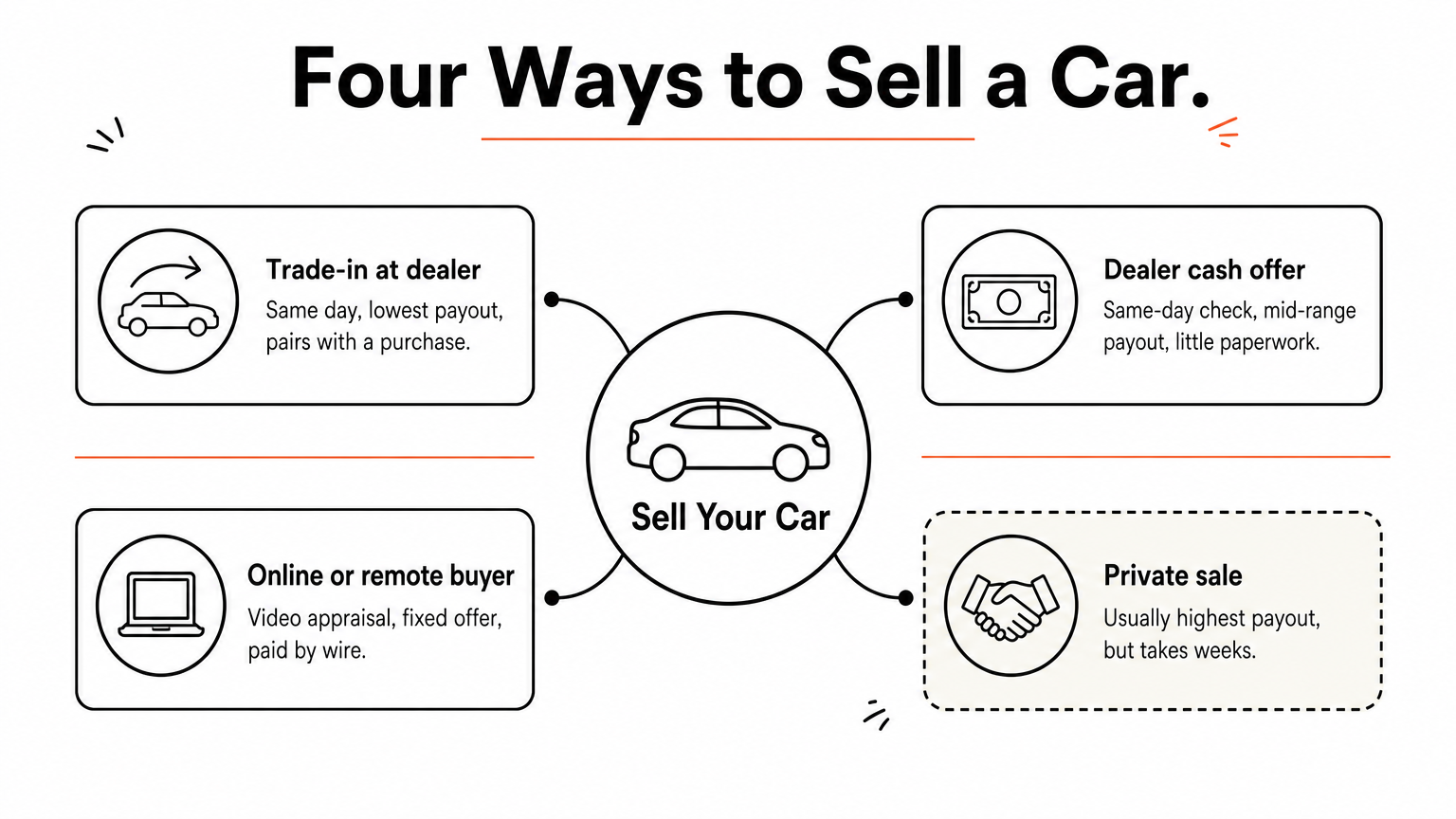
Compare the four routes
The table below sets the routes side by side so you can see the trade-offs at a glance.
| Route | Speed | Payout | Effort | Best for |
|---|---|---|---|---|
| Trade-in at a dealership | Same day | Usually the lowest, but many states tax only the price difference on your next car | Low | Buying another car right now |
| Sell to a dealer for cash | Same day to a few days | Mid-range | Low to medium | A check without a listing |
| Sell to an online or remote buyer | Same day to a few days | Mid to high, varies by buyer | Low | Offers without driving around |
| Private sale | Days to several weeks | Usually the highest | High | Popular models in clean condition |
No route wins on every measure. The extra money from a private sale pays you for your time and for the risk of strangers, test drives, and payment fraud. If the gap between a private sale and a strong cash offer is only a few hundred dollars, the cash offer is often the better deal.
Choose based on your situation
Start with your constraints, because they eliminate options fast.
- You still owe money: Any route works, but the lender must be paid from the proceeds. Buyers that handle payoff paperwork save you steps.
- You lease the car: Ask the leasing company whether it allows a sale and what the buyout amount is before you list anything.
- The car needs repairs or has high mileage: Private buyers will haggle hard over every flaw. A dealer or remote buyer prices the repairs in once.
- You need cash within days: Skip the private route.
- You hate negotiating: Choose a buyer with fixed offers.
If you want the fast route without the drive, a remote buyer such as Car Trackers appraises your car over smartphone video, gives a final offer right after the call, and pays by wire at pickup. Whatever you choose, get more than one number before you decide.
The best way to sell a car is the one that fits your deadline, not the one with the highest advertised price.
Step 1. Gather your paperwork
Before you contact anyone, collect the title, your photo ID, your registration, and your loan details if you owe money. Having these ready is what makes a same-day sale possible, because every buyer asks for the same documents and a missing one is the most common reason a deal stalls. Selling your car goes much faster when this is done first.
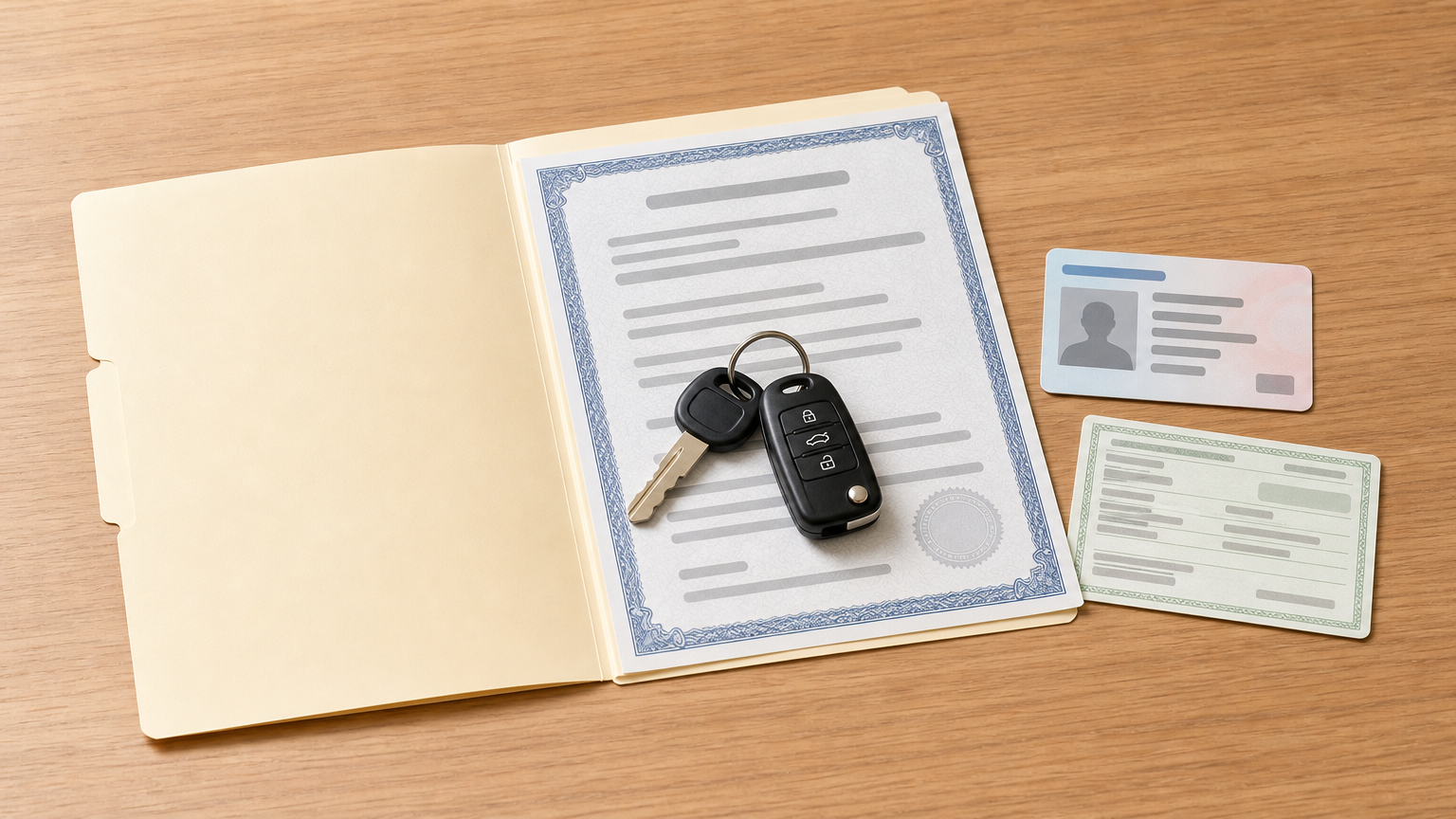
Documents every sale needs
Pull together this list and keep it in one folder.
- Title: The legal proof that you own the car. You sign it over to the buyer.
- Photo ID: A driver’s license or other government-issued ID that matches the name on the title.
- Registration: Current registration, so the buyer can confirm the VIN and plate.
- Loan or lease information: Lender name, account number, and a payoff quote (often called a 10-day payoff) from your lender.
- Service records: Not required, but they support your asking price.
- Keys and remotes: Every set you have. Missing keys can lower an offer.
- Bill of sale: Some states require one and some do not. Using one protects you either way.
Requirements vary by state, so check your state’s motor vehicle agency website for forms, such as a separate odometer statement or a seller notice of transfer.
What to do with no title or an open loan
If you cannot find the title, request a duplicate from your state’s motor vehicle agency before you list the car. Expect a fee and a wait that ranges from a few days to a few weeks, depending on the state. Buyers and dealers will not complete a sale without proof of ownership in most cases, and selling without one is illegal in many places.
If you still owe money, the lender either holds the title or has a lien recorded electronically. You ask for the payoff amount, the buyer’s payment goes to the lender first, and you keep any amount above the payoff. If the sale price falls below what you owe, you pay the difference at the time of sale. Check this number before you accept an offer, because it decides whether selling makes sense right now.
Locate your title and your payoff amount first, because everything else in the sale depends on them.
Step 2. Price your car and get it ready
Price your car from what similar cars actually sell for, not from one valuation number. Use two or three free online valuation tools, then check real listings of the same year, trim, and mileage near you. Asking prices are higher than selling prices, so treat them as a ceiling. This is the step that decides how much you get when you sell your car.
Find a realistic value
Valuation tools usually give separate figures for trade-in, private party, and retail. Those three numbers tell you what each route should pay. Trade-in and dealer offers sit near the bottom because the buyer must inspect, recondition, and resell the car. Private-party values sit in the middle, and retail is what a dealer asks on the lot.
For example, if similar cars list for $18,000 at dealerships, a dealer will offer well below that. A private buyer may pay closer to it. Your own car’s trim, options, color, and condition move the number, and so does the season. Convertibles do better in spring, and all-wheel-drive vehicles often do better in fall. Be honest about condition when you enter details, because every instant offer is based on the condition you report, and it gets adjusted if the inspection disagrees.
Prepare the car in one weekend
A clean car sells faster and gets better offers, and a weekend is enough.
- Wash, vacuum, and clear out personal items. Detailing is worth it for a private sale.
- Fix cheap problems like a burned-out bulb or a dead key fob battery. Skip big repairs, since you rarely get the cost back.
- Check for open safety recalls on the NHTSA recalls page using your VIN, so nothing surprises you.
- Photograph the exterior from all sides, the interior, the odometer, and any dents or scratches.
- Gather your service records in date order.
Photos do double duty. They build a private listing, and they back up your condition report when an offer is reviewed.
Price from what cars actually sold for, and report condition honestly so the first offer survives the inspection.
Step 3. Collect offers or list privately
Request at least three offers on the same day, then compare them against your valuation range. Offers move with market demand, so offers collected together are comparable and offers collected weeks apart are not. If you decide to sell your car privately instead, list it with strong photos and meet buyers safely.
Get offers from buyers
Submit your VIN or plate and the car’s condition to two or three buyers, such as a local dealer, a national instant-offer service, and a remote buyer. Ask each one how long the offer stays valid, whether it is binding after inspection, and how and when you get paid. A strong offer that pays in seven days can lose to a slightly lower one that pays today.
Car Trackers works like this. You submit your vehicle online, join a video call of about 10 minutes so an appraiser can see the car, and receive a final offer right after the call. There is no cost or obligation. Licensed appraisers handle the purchase agreement and title transfer, pickup is scheduled when it suits you, and payment is wired the same day as pickup. If you hold a competing dealer offer, we will match it or beat it by up to $1,000.
Sell privately without getting burned
A private sale pays best when the listing is thorough and your safety habits are strict. Write down year, trim, mileage, options, service history, and known flaws, and price slightly above your target to leave room for negotiation. Post it in more than one place.
Protect yourself at every step.
- Meet in a public place during the day, and bring someone along.
- Photograph the buyer’s license before a test drive and ride along.
- Accept payment at the buyer’s bank, or verify a cashier’s check directly with the issuing bank.
- Never accept a check for more than the price, and never refund the difference.
- Hand over the title only after the funds have cleared in your account.
Compare at least three offers received on the same day, and never release the title before the money is yours.
Step 4. Close the sale and transfer the title
Close the sale by signing the title exactly as your state requires, writing a bill of sale, and telling your state’s motor vehicle agency that the car is gone. The sale is not finished when the money arrives, because liability for the car follows the paperwork. Do this part carefully, whoever buys your car.
Sign the paperwork correctly
On the title, print and sign your name as shown, enter the buyer’s name and address, the sale date, and the odometer reading. Do not use correction fluid or cross anything out, since an altered title can be rejected and you may have to request a duplicate. If two owners are listed, check whether both signatures are required.
Then write a bill of sale, even if your state does not demand one. Include the date, price, VIN, mileage, both names and addresses, and the phrase "sold as is, without warranty." Both of you sign it, and each keeps a copy. Take photos of the signed title and bill of sale before the buyer leaves. With a buyer that handles the paperwork for you, still read what you sign.
Finish the loose ends
After the handoff, a few quick tasks protect you.
- File a notice of transfer or release of liability with your state’s agency, if your state offers one. This ends your responsibility for tickets, tolls, and accidents.
- Remove the license plates if your state requires the seller to keep them.
- Tell your lender the loan has been paid off, and confirm you receive a lien release.
- Cancel or change your insurance only after the sale is complete, and move it to your next car.
- Remove toll tags and wipe your phone connections and saved addresses from the infotainment system.
Keep your copies of the paperwork for at least a few years in case a question comes up later.
Your responsibility for a car ends only when the paperwork shows it changed hands.
Pick a route and start today
Selling a car well is a sequence, not a gamble. Choose the route that matches your deadline, gather the title and payoff details, price the car from real sales, compare offers from the same day, and finish with a signed title and a bill of sale. Do those steps in that order and you will avoid the usual traps of delays, lowball offers, and lingering liability.
If you want the quickest way to see what your car is worth without visiting a dealership, get your no-obligation offer from Car Trackers. A short video appraisal gives you a real number to compare against everything else you find.
