

The best sites for a used car sell by owner search are Cars.com, Autotrader, Kelley Blue Book, Edmunds, AutoTempest, Craigslist, and Facebook Marketplace. A good pick lets you filter to private sellers, set a radius around your zip code, see the price against the market, and message the owner directly. Cars.com and Autotrader suit most buyers. Kelley Blue Book and Edmunds suit anyone who wants a price check built in. AutoTempest suits people hunting one specific model, and Craigslist and Facebook suit bargain hunters who will inspect cars in person.
The problem is that private-party listings are scattered. Many sites mix dealer inventory with owner ads, some default to nationwide results until you enter a zip code, and a low price means little if the seller cannot produce a clean title. This guide ranks seven places to look and shows what each one gives you, who it fits, and where it trips buyers up. It then gives you a search routine and a checklist for vetting a seller before you hand over money.
Car Trackers sits on the other side of these listings. We help owners sell by video appraisal instead of posting an ad.
1. Cars.com
Cars.com is the best first stop for used cars for sale by owner because it has a dedicated private-seller page and a large national pool. The site says it lists more than 10,000 vehicles nationwide, and you can save listings and contact sellers directly.
Start with the site that lets you filter to private sellers by price and body style, then widen from there.
How it works
Each private listing shows the asking price, mileage, the seller’s first name, the city, and the distance from you. It also shows an estimated monthly payment, the VIN, a feature list, and owner reviews of that model. You reach the seller through a Contact Seller button. The site also has ready-made pages that narrow the search:
- Price pages from under $2,000 up to under $100,000
- Body style pages for SUVs, sedans, trucks, minivans, wagons, and vans
- Saved listings so you can compare finalists side by side
Best for and drawbacks
Cars.com suits buyers who already know their budget and body style. Jump to the price page that matches your ceiling and sort by newest, because good private cars sell fast.
The estimated monthly payment is a calculator figure, not a loan offer, so ignore it when judging value. The VIN is printed on the listing, which means you can run a history report before you ever contact the seller.
2. Autotrader
Autotrader is the strongest pick for buyers who want a verified-seller feel and the option to finish more of the purchase online. Its by-owner page lists used cars, trucks, and SUVs from private sellers near you, and its marketplace page promises verified sellers.
Autotrader suits first-time private buyers, but confirm which paperwork still lands on you.
How it works
You search with the private-seller filter, set your zip code and radius, and message sellers through the site. The marketplace route is built around buying without a trip to the DMV. Autotrader’s page says you can buy 100% online and skip the DMV. Three features matter most:
- Private-seller search across cars, trucks, and SUVs
- Verified sellers on the marketplace side
- An online purchase flow that Autotrader says can replace a DMV visit
Best for and drawbacks
This is the best option for someone nervous about a first private purchase. Verification and a guided flow lower the risk of a no-show seller or a messy handoff.
Title and registration rules differ by state, so ask exactly what the online flow handles and what you still file yourself. Read Autotrader’s fee and terms pages before you commit, because the marketplace flow is a service with its own rules.
3. Kelley Blue Book
Kelley Blue Book is the best pick when your main question is whether the price is fair. Its by-owner results carry price labels such as Good Price and Great Price, and some listings show a No Accidents tag.
Treat a price badge as a prompt to look closer, never as proof the car is sound.
How it works
You search with a seller-type filter and a radius, and each card shows mileage, distance, and a price label. Price drops are flagged too. Some private listings run through a Private Seller Exchange, shown with the line "Buy Online. Clean title. No Hassle." Keep these points in mind:
- Price labels such as Good Price, Great Price, and Price Drop
- A radius filter that sorts private cars by distance
- Dealer cars and sponsored cards mixed into the same page
Best for and drawbacks
Kelley Blue Book fits buyers who want to anchor a negotiation in market data. If the label says Good Price and you still push for a few hundred dollars off after an inspection, you are negotiating from facts.
The page also slips in dealer cars marked "Dealer Fees Included," so check the seller type on every card. A badge is an algorithm’s read on price, not on condition. A high-mileage car can earn a Great Price label and still need serious work.
4. Edmunds
Edmunds is best when you want every listing rated against the market. Each by-owner card shows a price rating, such as "great price," and the dollar gap below market. It also shows mileage, seller type, and distance.
Set your zip code first, or Edmunds will show you cars hundreds of miles away.
How it works
The by-owner page opens with nationwide results and asks for your zip code to localize them. You can then filter by seller type, price rating, mileage, year, body type, drivetrain, and MPG. Cards also list features such as back-up camera, navigation, and leather seats.
- Price rating and dollars below market on each card
- Seller type filter to isolate private listings
- Miles-away figure on every result
Best for and drawbacks
Edmunds suits analytical buyers who like to sort by how far under market a car sits. It makes a strong second search after Cars.com, because the ratings help you spot the real bargains.
Be skeptical of a very large below-market gap. A car priced thousands under market may have a title problem, hidden damage, or a seller who needs it gone, so ask why before you drive out. Cars far from you also carry travel or shipping costs that erase part of the discount.
5. AutoTempest
AutoTempest is best when you want one specific model and do not want six browser tabs open. It says it brings together more than 2 million privately listed cars from the major used car sites, including Cars.com and eBay.
A meta-search saves time, but the protections you get are those of the original site.
How it works
You enter a make, model, and radius, and AutoTempest returns combined results. Each listing links back to the source site, and that is where you contact the seller. Its main features are:
- One search across several marketplaces
- A focus on privately listed cars
- Click-through to the original listing for contact and details
Best for and drawbacks
This tool fits buyers chasing a particular trim, color, or a less common model. A single search shows you the whole market for it, so you can spot a fair price quickly.
AutoTempest is a search layer, not a marketplace. Seller verification, fees, and buyer protections come from whichever site holds the listing. You may also see the same car posted in more than one place, so check the VIN before you assume you have found two cars.
6. Craigslist
Craigslist is best for local, no-frills deals where you can meet the owner within a day or two. Open the cars and trucks category and filter by owner to hide dealer posts.
Craigslist rewards speed and caution in equal measure, because nothing is verified for you.
How it works
Listings are organized by city, with photos, a text description, and a way to contact the seller through the site or by phone. You can widen the search to nearby areas. There are no price ratings and no history reports, so the research is yours. The core tools are:
- The by-owner filter inside cars and trucks
- City-based listing pages
- Direct contact with the seller by message or phone
Best for and drawbacks
Craigslist suits buyers of older, cheaper cars who are comfortable inspecting a vehicle and handling the paperwork themselves. The best deals come from sellers who just want a fast, simple sale.
There is no verification and no buyer protection. Watch for sellers who refuse to meet, ask for a deposit before you see the car, or offer a vague "escrow" arrangement. A price that looks far too good is usually bait. Never pay before you have seen the car and the title together.
7. Facebook Marketplace and groups
Facebook Marketplace is best when you want to see who you are dealing with. Listings link to the seller’s profile, and local or state groups focus on used autos sold by owners.
A profile gives you context, but a title check still has to come from official records.
How it works
You search Marketplace by location and vehicle type, then message the seller in the app. Groups add a second channel, because owners post there before they list elsewhere. One state-level used-car group tells buyers to confirm with the DMV, using the title number, that the title is free of liens before paying. Rules and services vary by state, but the habit is sound anywhere.
- Marketplace search by location and category
- Seller profiles you can review before you message
- Local and state used-car groups
Best for and drawbacks
This route fits buyers who want to vet the seller as a person and who like negotiating in chat. A profile with a long history and real photos is a good sign.
New or empty profiles deserve caution. So do repeat posters who are really curbstoners, which means unlicensed dealers posing as owners. Ask a simple question: "Is the title in your name?" A hesitant answer tells you what you need to know.
Which site fits which buyer
Use Cars.com and Autotrader as your core searches, add Kelley Blue Book or Edmunds for price checks, and bring in Craigslist and Facebook when you want the cheapest cars. AutoTempest is the shortcut for one exact model.
Run two core searches, one price-check search, and one local classifieds search, then compare.
Side-by-side comparison
| Site | Best for | Standout feature | Main catch |
|---|---|---|---|
| Cars.com | All-round browsing | Private-seller page with price and body-style filters | Payment estimates are not loan offers |
| Autotrader | Guided buying | Verified sellers and an online purchase option | Fees and DMV steps vary, so read the terms |
| Kelley Blue Book | Price checks | Good Price and Great Price labels | Dealer cars mixed into results |
| Edmunds | Market-rated listings | Dollars below market on each card | Nationwide default until you add a zip |
| AutoTempest | One specific model | Many sites in one search | Duplicates, and protections come from the source site |
| Craigslist | Cheap local deals | Simple owner filter | No verification or buyer protection |
| Facebook Marketplace | Vetting the seller | Visible profiles and local groups | Curbstoners and thin profiles |
A search routine that saves time
This order keeps you from wasting a weekend on cars you will rule out later.
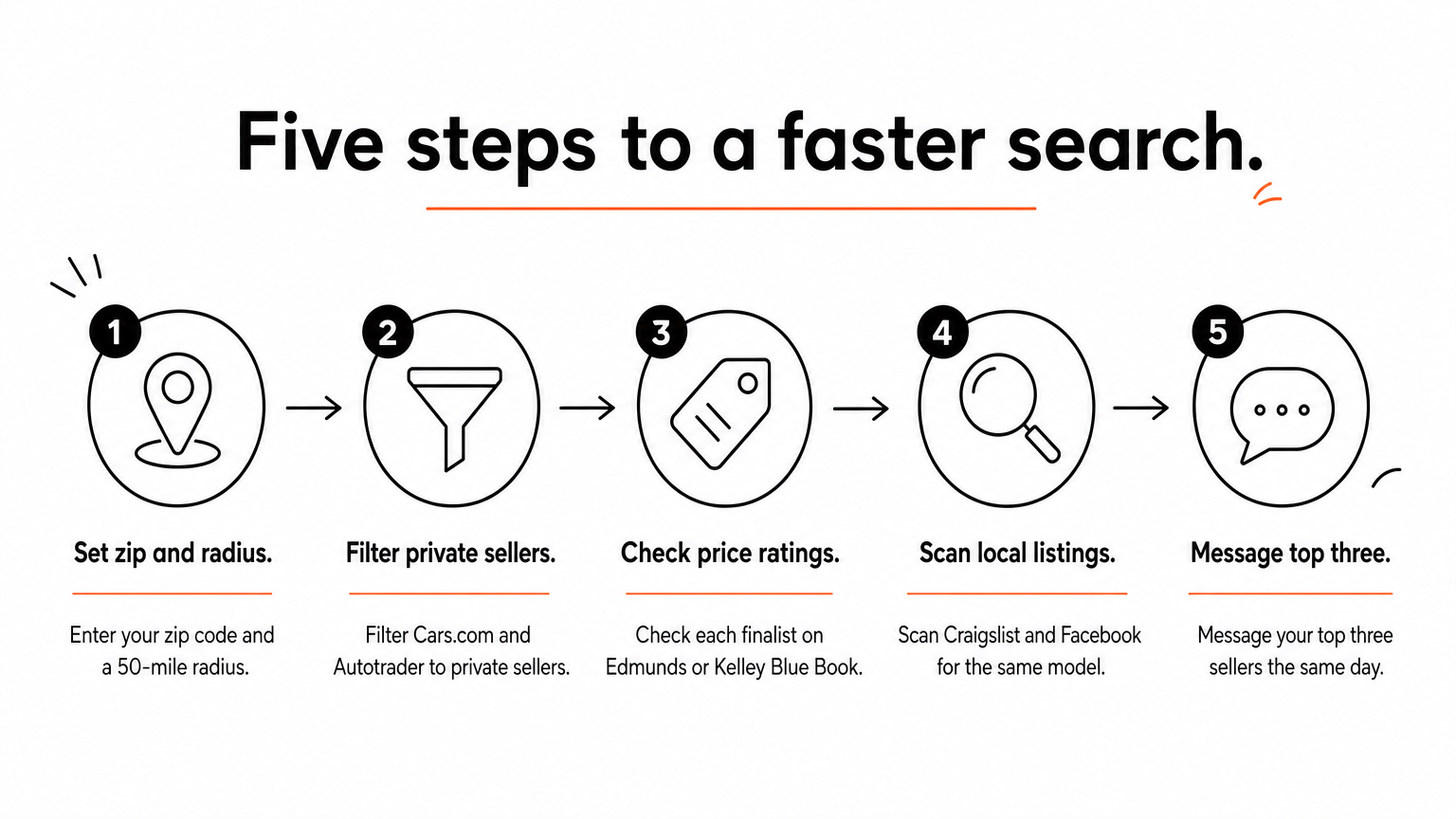
- Set your zip code and a radius you will realistically drive, such as 50 miles.
- Filter to private sellers on Cars.com and Autotrader and note every car that fits your budget.
- Check each finalist’s price rating on Edmunds or Kelley Blue Book.
- Scan Craigslist and Facebook for the same model, since cheap cars often appear there first.
- Message your top three sellers the same day and ask about the title and service records.
How to vet a private seller before you pay
Vet a private seller by confirming the title, inspecting the car, and paying in a way that leaves a paper trail. Do these in that order, because a bad title ends the deal no matter how good the car feels.
If the seller cannot show a clean title in their own name, walk away.
Check the title and VIN first
Ask for the VIN and a photo of the title before you visit. The name on the title should match the seller’s ID, and the VIN on the title should match the one on the dashboard and the door jamb. Run a history report for accidents, odometer problems, and salvage or flood brands. Then confirm there is no lien. If a bank still holds a lien, the seller must pay it off before the title can move to you.
- Seller’s name on the title matches their ID
- VIN matches the title, dashboard, and door jamb
- History report is clean of salvage, flood, and odometer flags
- No lien, or a documented payoff plan
Inspect and test drive
Drive the car in daylight, cold if you can. A warm engine hides hard starts. Check for uneven tire wear, fluid leaks, warning lights, and a smooth shift at highway speed. Then pay an independent mechanic for a pre-purchase inspection, which usually costs somewhere around $100 to $200. A seller who refuses an inspection is telling you something.
Here is a worked budget. Say the asking price is $8,500. Add a $150 inspection and a $40 history report, and you have spent $8,690 before tax, title, and registration fees. If the inspection finds $600 in needed repairs, you have a documented reason to ask for that amount off.
Pay and transfer the title safely
Meet at your bank or the seller’s bank, and use a cashier’s check or a bank transfer that leaves a record. Do not send money to someone you have not met, and do not accept a story that involves a third-party "escrow" service you did not choose.
Get a signed bill of sale that lists the price, date, VIN, and both parties’ names, and make sure the seller signs the title over to you at the handoff. The steps to transfer car ownership and register it differ by state, so check your state DMV’s website for the exact forms and deadlines.
Your next step
The best sites for used cars for sale by owner give you three things: a private-seller filter, a way to judge price, and a direct line to the seller. Start with Cars.com and Autotrader, check prices on Edmunds or Kelley Blue Book, and use Craigslist and Facebook for local deals. Whatever you find, verify the title and VIN, get an inspection, and pay with a paper trail.
If you also have a car to move, you do not have to run a private sale yourself. Car Trackers appraises vehicles by a short video call, gives a final offer instantly, and arranges pickup, with no cost or obligation. Get your instant car offer from Car Trackers and compare it with what a private buyer would pay.
