

When you type used cars sell by owner near me into a search bar, the fastest route to a good deal is a five-step routine. Set a total budget, search several private-seller listing sites with a radius filter, message owners with screening questions, inspect the car and check its history, then close with a signed title, a bill of sale, and safe payment. Skip a step and the savings of a private sale can disappear into repair bills or paperwork trouble.
The problem is that private listings are scattered across many sites, and quality varies a lot. Nobody stands behind the car once you pay. There is no dealer, no return window, and no service department to call. Scammers and unlicensed resellers also pose as ordinary owners, and plenty of buyers lose weekends driving to cars that look nothing like the photos.
This guide walks through the whole process in order. Car Trackers buys vehicles from owners through a short online video appraisal. You will get a worked budget, a comparison of where to search, a message template you can copy, an inspection checklist, and a closing checklist for the paperwork and payment.
Why buy from an owner, and what you give up
Buying from a private seller usually costs less than buying the same car at a dealer, but you take on the inspection, paperwork, and risk that a dealer would otherwise handle. Weigh that trade before you open a single listing.
What you gain from a private sale
A private seller has no lot, sales staff, or reconditioning department to pay for, so asking prices tend to run lower than dealer prices for a comparable car. You also skip add-ons such as documentation fees, and you negotiate with the person who makes the decision, not a manager in a back office.
The second gain is information. The owner knows how the car was driven, where it was parked, and what has broken. A seller with a folder of service records is worth more to you than a spotless car with no history at all.
What you give up
Private sales are almost always as-is. There is no warranty, no return window, and in most states lemon laws do not cover a private used-car purchase. The FTC’s Used Car Rule, which requires the Buyers Guide sticker on dealer cars, applies to dealers, not individuals. You can read the basics on the FTC’s used car page. Once the money changes hands, every repair is yours.
| Private seller | Dealer | |
|---|---|---|
| Price | Often lower, more room to negotiate | Often higher, may add fees |
| Warranty | None, unless factory coverage still transfers | May offer limited or paid coverage |
| Paperwork | You and the seller handle the title transfer | Dealer usually handles it |
| Financing | You arrange your own loan | Offered on site |
| Recourse after sale | Rarely any | Varies by dealer and state |
A private sale saves you the dealer’s margin and hands you the dealer’s job.
Step 1. Set your budget and shortlist models
Set a total out-the-door budget before you browse, because the asking price is only part of what a private-sale car costs you. Decide what you can spend overall, then work backward to the price you can actually shop at.
Budget the full cost, not the asking price
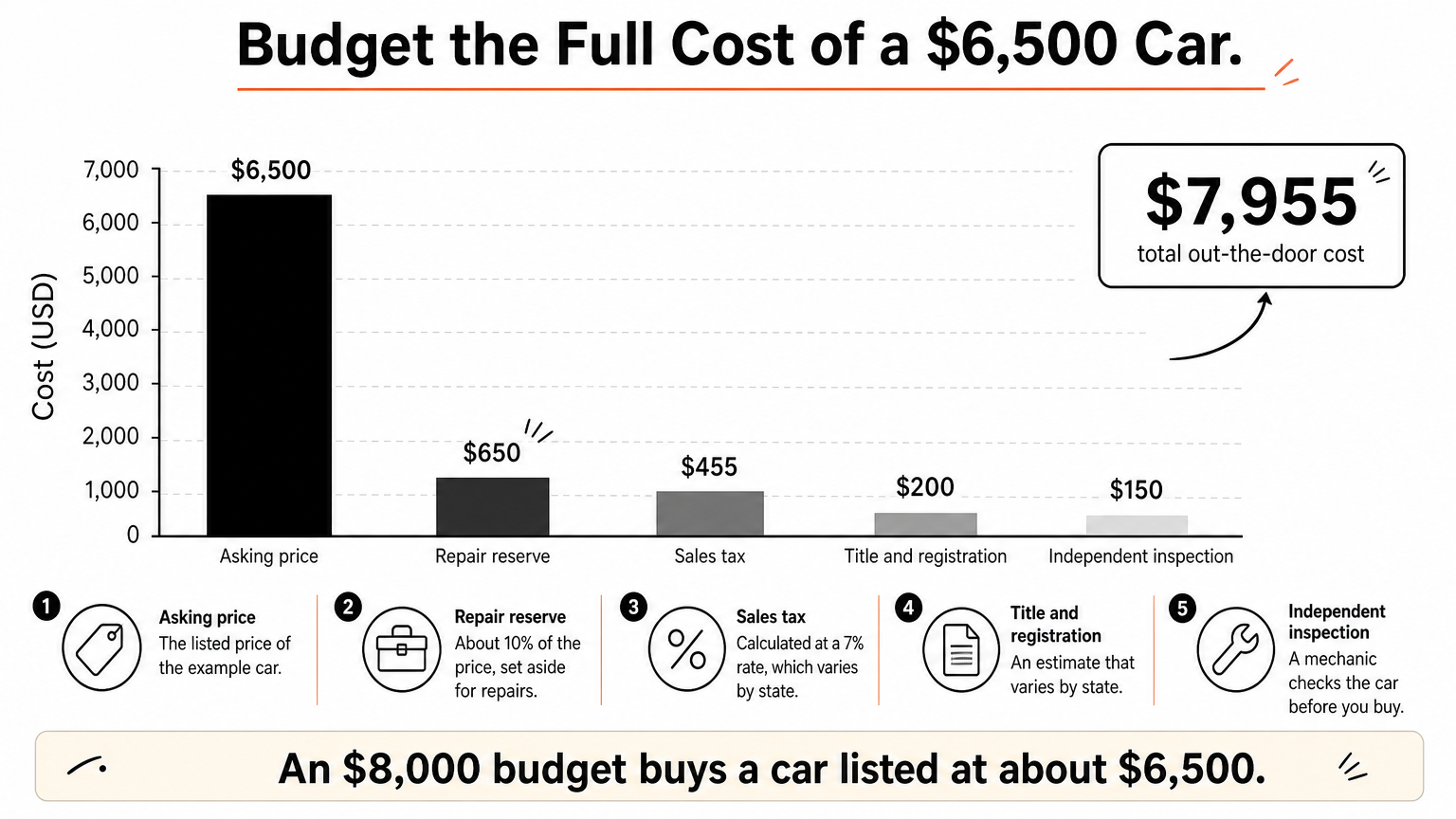
Add sales tax, title and registration, an inspection, and a repair reserve of about 10% of the price. Most states collect sales tax when you register the car, even on a private sale. The example below uses a 7% rate and a $200 registration estimate, and both vary by state.
| Item | Amount |
|---|---|
| Asking price | $6,500 |
| Sales tax at 7% | $455 |
| Title and registration | $200 |
| Independent inspection | $150 |
| Repair reserve (10% of price) | $650 |
| Total | $7,955 |
So an $8,000 budget buys a car listed at about $6,500. You may see a "$3,000 rule" mentioned online. It is not an official rule, and sources define it differently, so don’t build your budget on it. The repair reserve does the same job and scales with the price.
Pick two or three models first
Choosing models before you search keeps you from falling for a random listing. Pick cars with cheap parts and a long-lasting reputation, such as the Corolla, Camry, Civic, or Accord, and then research the problems of the exact model year. NHTSA’s recall and complaint data and owner forums will tell you which transmissions or engines to avoid.
Your price tier sets your expectations. Under $3,000, expect 150,000 miles or more and cosmetic flaws, so buy on mechanical condition alone. Between $3,000 and $5,000 you can find cleaner cars, but you still need to verify maintenance because many sellers at this level skipped it.
Line up funding and your current car
If you need a loan, get preapproved by a bank or credit union first and confirm the lender finances private-party purchases. Not every lender does. Cash buyers have more leverage, so a firm budget helps either way.
If you are replacing a car, sell it on a schedule that matches your purchase. Car Trackers can help here: you submit the vehicle online, complete a 10-minute video call appraisal, and get a final offer instantly. If you accept, payment is by same-day wire when the car is picked up. The appraisal is free and carries no obligation, so you can learn your current car’s value before you set your budget.
Your real budget is the asking price plus about 20% in costs and reserves.
Step 2. Search the right sites near you
Search at least three sources, filter to private sellers only, and set a radius around your ZIP code. One car often appears on several sites, so cross-checking also shows you who is repeating listings.
Where to find cars sold by owners
| Source | How to see only owners | Strength | Watch out for |
|---|---|---|---|
| Craigslist | Open cars & trucks, then filter by owner | Local, low prices, older cars | Little verification, so screen every seller |
| Facebook Marketplace and local buy/sell groups | Check each seller’s profile | You can see who you deal with | Fake or brand-new profiles |
| Cars.com | Use the for-sale-by-owner page; listings show "Private seller" and distance | Easy to judge distance | Wider radius results can mix in dealer listings |
| Autotrader and Kelley Blue Book | Use the by-owner search pages | Filters for price, mileage, and features | Many results are dealer cars if you skip the filter |
| Edmunds and iSeeCars | Look for the "For Sale By Owner" tag or by-owner search | Price-versus-market labels | A market label is an estimate, not an inspection |
Don’t ignore offline channels. Coworkers, neighbors, credit union bulletin boards, and cars with a sign in the window often lead to owners who never list online. These sellers tend to be less rushed and more honest, simply because they know you.
Filters that save time
Set the same filters on every site so you can compare results fairly:
- Seller type: private seller or by owner only.
- Radius: start at 25 miles and widen to 50 only if the shortlist is thin.
- Price cap: your asking-price limit from Step 1, which is $6,500 in the example.
- Mileage and year: a ceiling that fits your shortlist of models.
- Sort: newest first, so you reach good cars before other buyers do.
Save the search and turn on alerts. Good cars at fair prices often sell within days, so the buyer who messages first has the advantage.
Read the listing before you message
A good listing has many photos in daylight, including the odometer, the interior, and the engine bay. It names the trim, gives the mileage, and mentions service history and known flaws. A listing with one blurry photo and "runs great, call me" usually means the owner expects a quick, uncritical sale.
Treat price as information. A car priced well below similar listings is not a bargain until proven otherwise, and the usual reason is a salvage title, a hidden problem, or a scam. Compare each asking price against three similar listings and a valuation guide.
The best private listings answer your questions before you ask them.
Step 3. Contact owners and screen them
Message the owner first, prove you are a serious buyer, and ask a handful of screening questions before you drive anywhere. A five-minute exchange filters out most cars that would have wasted your afternoon.
Copy this first message
Short, specific messages get replies. Paste this and fill in the brackets:
Hi [Name], I'm interested in your [year make model] listed at [price]. Is it still available?

Before I come see it, a few quick questions:
1. Are you the owner on the title, and is the title clean (not salvage or rebuilt) and free of any loan?
2. What is the current mileage, and do you have service records?
3. Has it had any accidents or major repairs?
4. Are there any warning lights or known problems?
5. Would you be fine with my independent mechanic inspecting it at my cost?

I can come [day] between [time] and [time]. Thanks, [Your name]
The last question matters most. Honest owners say yes, sometimes with a condition such as a nearby shop. Anyone who refuses is telling you something about the car.
Judge the answers
Good answers are specific and consistent. "Oil changes every 5,000 miles, here are the receipts" beats "I took care of it." Check that the mileage matches the listing and that the story for selling makes sense. Vague replies, long delays on simple questions, and pressure to decide fast are warning signs.
Also confirm the name on the title matches the person you will meet. If the seller says the car belongs to a friend or relative, ask to meet the actual owner or walk away. Buying with the title still in someone else’s name, often called an open title, can leave you unable to register the car.
Spot scam signals early
Most private sellers are ordinary people, but a few patterns should end the conversation:
- A price far below every comparable listing.
- A seller who cannot meet in person, or says the car is "at a shipping company."
- A request for a deposit, gift cards, or a wire transfer before you have seen the car.
- A refusal to share the VIN or let you see the title.
- Several cars listed under one phone number, a sign of an unlicensed reseller posing as an owner.
If the seller won’t let a mechanic look at the car, walk away.
Step 4. Inspect, test drive, and verify the car
Inspect the car in daylight, drive it at least 20 minutes, run a VIN history check, and pay an independent mechanic to look it over before you agree on a price. Each check catches problems the others miss.
Walk-around checklist
Bring a flashlight, a paper towel, and a friend. Go through the car in this order:
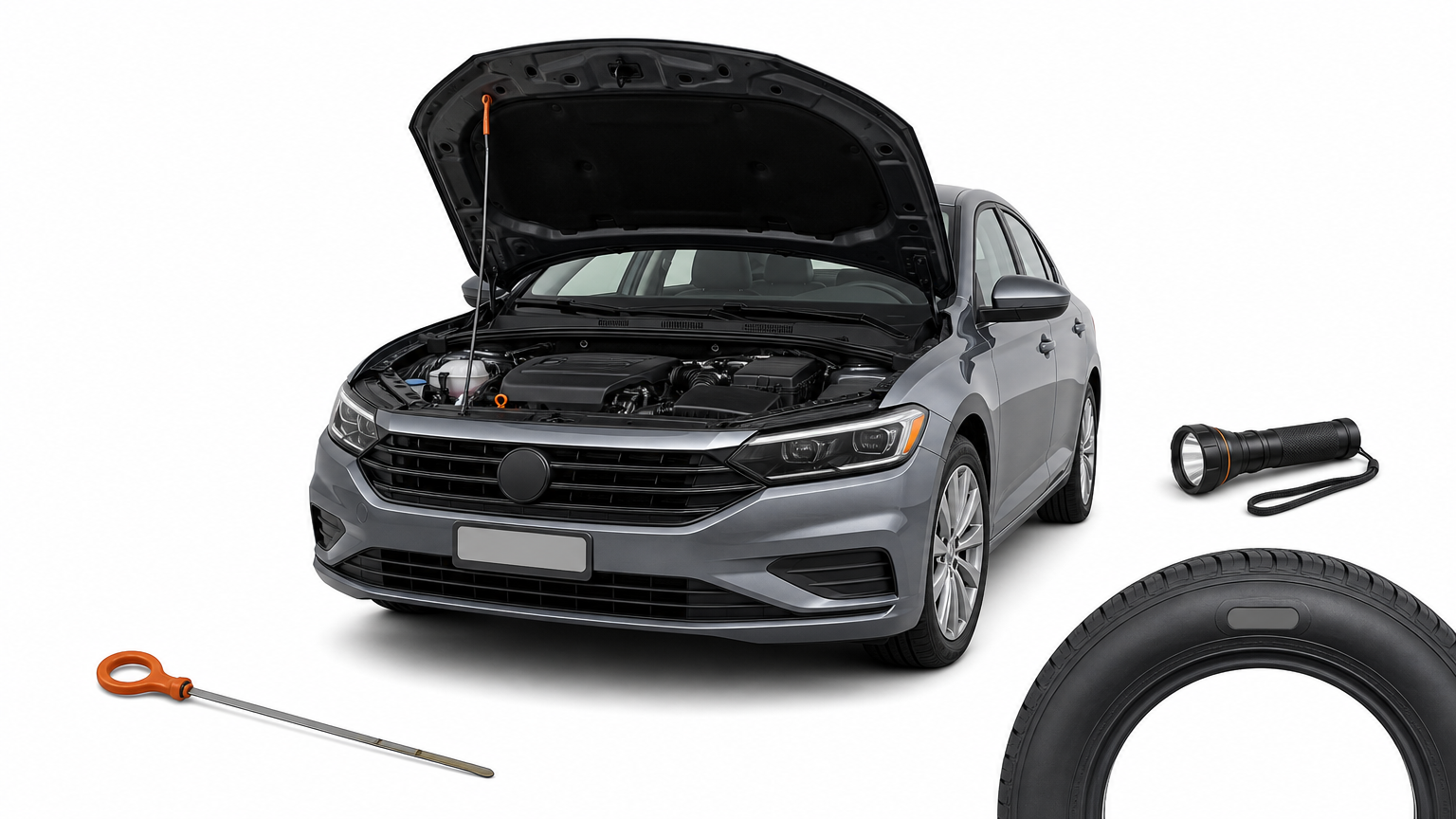
- Panels and paint: uneven gaps or mismatched shades suggest past repairs.
- Tires: matching brands and even wear. Check the four-digit date code, since tires older than about six years need replacing even with good tread.
- Under the hood: leaks, cracked belts, and oil on the dipstick. A milky color can mean coolant is mixing in.
- Underneath: rust on the frame, or fresh undercoating that may hide it.
- Interior: a musty smell, damp carpet, or silt under the seats can mean flood damage. Test every window, switch, and the A/C and heat.
- Dashboard: warning lights should come on at startup and then go off. A light that never appears may have been disabled.
Ask the owner not to warm the car up before you arrive. A cold start reveals hard starting, smoke, and rough idle that a warm engine hides.
Test drive properly
Drive a mix of city streets and a highway at 60 mph or more. Listen for grinding, clunks, or whining, and feel for vibration, pulling, or hesitant shifts. Brake firmly from speed on an empty stretch, and make a full-lock turn in a parking lot to check for noises from the steering and axles. Bring your license and proof of insurance, since the owner may ask for both.
Verify the VIN and history
The VIN has 17 characters and appears on the dashboard (visible through the windshield), the driver’s door jamb, and the title. All three must match. Then run these checks:
- Recalls: enter the VIN at NHTSA’s recall lookup to see open safety recalls, which dealers fix free.
- Title history: the government site vehiclehistory.gov lists approved providers of NMVTIS reports, which flag salvage, junk, and flood brands.
- Service and accident history: commercial reports such as Carfax or AutoCheck add records, but they miss unreported repairs.
Finally, book a pre-purchase inspection at an independent shop you choose, not one the seller recommends. It commonly costs $100 to $200, though prices vary by area and vehicle. A written list of problems, with repair quotes, becomes your negotiating tool.
A clean history report plus a clean mechanic’s report is the closest thing to a warranty a private sale offers.
Step 5. Negotiate and close the sale
Negotiate with evidence from the inspection and comparable listings, then close with a signed title, a bill of sale, and payment through a bank. Never hand over cash in a parking lot before the title is signed.
Negotiate with evidence
Anchor your offer in facts. Say the owner asks $6,500, and your mechanic finds worn rear brakes and a leaking valve cover gasket, quoted at $750. You can reasonably offer $5,750 ($6,500 minus $750), show the quote, and expect a counter near $6,000. Accept anything within your Step 1 budget and walk away from anything that is not.
Stay polite and specific. Sellers respond better to "the shop quoted $750 for these two repairs" than to a lowball with no reason. And keep your walk-away number fixed before you arrive, because the pressure to close is highest when you are standing next to the car.
Complete the paperwork
Rules differ by state, so check your state’s DMV site, but these items cover most private sales:
- Signed title: the seller’s name matches their ID, and the title shows no lien.
- Lien release: if the owner still has a loan, complete the deal at the lender’s branch so the loan is paid off and the title released.
- Bill of sale: two signed copies with the details below.
- Odometer disclosure: the mileage recorded on the title or the required form.
- Release of liability: the seller files it with the DMV, which protects them from tickets after the sale.
- Insurance and inspections: insure the car before you drive it away, and confirm whether your state requires emissions or safety inspections.
BILL OF SALE
Date: [date]
Seller: [full name, address]
Buyer: [full name, address]
Vehicle: [year, make, model], VIN [17-character VIN]
Odometer reading: [miles]
Sale price: $[amount]
Condition: Sold as-is, with no warranty expressed or implied.
Signatures: Seller ________  Buyer ________
Pay safely and register
Meet at your bank or the seller’s. A cashier’s check issued in front of you, or a bank transfer, leaves a clear paper trail and avoids carrying thousands in cash. Skip gift cards and prepaid cards entirely. If you pay with a cashier’s check from another bank, confirm it with the issuing bank before you sign.
After the sale, take the signed title, bill of sale, ID, and proof of insurance to the DMV to register the car in your name. Do it promptly, since most states set a deadline and charge penalties after it.
The sale isn’t finished until the title is signed, the lien is cleared, and you hold proof of payment.
Ready to buy or sell your own car?
Finding a good used car from an owner comes down to a repeatable routine. Budget for the full cost, search several sites with a private-seller filter, screen sellers with the same questions, inspect and verify before you negotiate, and close through a bank with a properly signed title. Skip none of it, and a private sale can save you real money.
If you are replacing a car as part of this purchase, you don’t have to haggle with dealers or strangers to sell your current one. You can get a free, no-obligation offer from Car Trackers through a 10-minute video appraisal and know your car’s value before you shop.
