

So, where can I sell my car for the most money? A private sale sets the highest ceiling because the buyer pays retail price, but it costs you time and carries scam risk. For most owners, the better answer is competing offers from buyers who want your exact car. Car Trackers suits busy sellers who want a dealer-beating offer without leaving home. Carvana and CarMax suit people who want a fixed number in minutes. A local dealer suits anyone trading in, and auction sites suit rare cars.
The trouble is that quotes for the same car can differ by thousands of dollars, and no single site wins every time. Your car, your area, your loan balance, and your patience all change the answer. Picking the first offer you see is the most expensive of the car selling mistakes to avoid.
This guide ranks eight places by realistic payout, effort, and risk. Car Trackers buys cars remotely, so we see how offers are built, and we will say plainly when a private sale or another buyer is the better choice for you. Use the comparison table near the end to pick fast.
1. Car Trackers
How it works
Car Trackers is a remote buyer, so you can sell your car from home and the whole sale happens from your driveway or couch. You submit your vehicle details online, then join a 10-minute video call on your smartphone. A licensed appraiser walks through the car with you on camera and prices the condition you show. The steps are short:
- Submit your vehicle’s year, make, model, and mileage online. Any year, make, or model can get an offer.
- Show the car on a 10-minute smartphone video call.
- Receive a final offer right after the call, with no in-person visit.
- Accept, and the appraisers handle the purchase agreement and title transfer.
- Pick a pickup time that suits you and get paid by wire the same day the car leaves.
What you can expect to earn
Car Trackers has no showrooms or large lots to pay for, and that low overhead is why it can beat most dealer offers. It also backs its offers with a price-match or beat guarantee against competing dealer quotes, worth up to $1,000 more. The appraisal and the offer cost nothing and carry no obligation.
That guarantee changes how you shop. Collect your best dealer quote first, then bring it to the video call. Your best competing offer stops being the ceiling and becomes the floor.
Bring your best dealer quote to the call, and let it work as the floor, not the ceiling.
Who it suits and the catch
Car Trackers fits owners who want strong money without the shuffle. That includes people upgrading to a new vehicle, people getting out of a lease, and anyone who hates negotiating or does not want strangers visiting the house. If you feel cautious about selling online, the video call lets you see who you are dealing with, and licensed appraisers handle the paperwork that trips up many private sellers.
The catch is simple. The appraisal reflects the condition you show on camera, so show everything honestly, including dings and warning lights. A patient private seller in a strong market can also still earn more than any buyer, us included. Compare first, then decide. When you are ready, you can request an offer from Car Trackers in a few minutes.
2. Private sale on Facebook Marketplace and Craigslist
How it works
A private sale means you are the dealer, and a step by step guide to selling your car privately helps you handle every part. You list the car yourself on Facebook Marketplace or Craigslist, both of which let you post for free or close to it. Then you field messages, show the car, and close the deal. A strong listing does most of the work:
- Daylight photos of all four corners, the interior, the dashboard with the odometer showing, the tires, and the engine bay.
- A plain description with year, trim, mileage, service history, and known flaws.
- A price set just above your true floor, based on similar cars listed near you.
Screening matters as much as the listing. Keep conversations inside the platform’s messaging, meet in a public place, and verify payment at the buyer’s bank before you hand over the title. Never accept a personal check, and be wary of any buyer who offers more than your asking price.
What you can expect to earn
Private sales usually pay the most because the buyer pays retail and there is no dealer margin or reconditioning cost to subtract. If you want to sell your car for the most money and your car is popular and well kept, the gap over a trade-in can be large. The gap shrinks fast when you overprice, skip service records, or let the listing sit for weeks.
A private sale pays the most on paper and costs the most in time.
Who it suits and the catch
This route suits patient sellers with an in-demand car, a flexible schedule, and comfort around strangers. Expect lowballers, no-shows, and test-drive logistics. You also own the paperwork, including the bill of sale, the title signature, and in many states a release-of-liability filing. Rules vary by state, so read your DMV’s guidance before you list.
Price matters here too. Buyers who need financing often prefer dealers, which narrows your pool on higher-priced vehicles. If you owe money on the car, the lender must be paid and the lien released before the title can move, which adds steps.
3. Paid listings on Autotrader, Cars.com and CarGurus
How it works
Paid listing sites work like Marketplace with a filter on buyer quality. You create a paid listing, usually with photos, a description, and your VIN, and shoppers searching by make, model, and price find you. Some packages include a vehicle history report for buyers, which answers the first question most of them ask.
Fees differ by site and package. Some charge when you list, some charge again when the car sells, and the amounts change often. Check the current price list before you pay. The rest of the process matches a private sale: you answer messages, host test drives, and collect payment.
What you can expect to earn
You can expect close to retail value, the same as any private sale, with one advantage. Shoppers on these sites are actively comparing cars, so you attract fewer tire-kickers and more people ready to buy. Buyers can also see how your price stacks up against similar cars, which rewards honest pricing.
The fee is a real cost. On a lower-priced car it eats a visible share of your gain, and on a newer, higher-priced car it barely registers.
Pay for a listing only when the car is worth enough that the fee disappears into the price.
Who it suits and the catch
Paid listings suit late-model, in-demand vehicles where the fee is small next to the sale price. They also suit sellers who want to sell their car for the most money but would rather avoid the bargain-hunting crowd on free classifieds.
The catch is that you pay whether or not the car sells, and you still do all the private-sale labor. Scam rules are unchanged. Verify funds at a bank, and release the car only after payment has cleared. If your car is older or has high mileage, a free listing is usually the smarter first move.
4. Instant offers from dealer networks
How it works
Several big car sites, including Autotrader with Kelley Blue Book, CarGurus, Cars.com, Edmunds, and TrueCar, offer instant-offer tools. You enter your VIN or license plate, answer condition questions, and your details go to partner dealers. On some sites, such as CarGurus, dealers bid against each other and you see the strongest offer. If you accept, a dealer confirms the car and arranges pickup or a visit. Exact steps vary by site.
What you can expect to earn
Expect a mid-to-strong wholesale-style offer. A dealer bidding because they have a buyer lined up for your model can beat a single trade-in appraisal. The offer depends on what you entered, though, so it can shift at inspection if the car differs from your description.
Each site pulls from a different dealer pool. Running two or three tools in one sitting often shows a spread of offers for the same car.
Each site asks a different group of dealers, so asking more than one site is free money.
Who it suits and the catch
These tools suit sellers who want to see the market quickly and would rather skip the work of listing. They help most when you use them as price discovery, a way to learn what dealers will pay before you decide where to sell.
The catch is the follow-up. Submitting your details can trigger calls and texts from dealers, so use a number you do not mind sharing. The offers are also conditional. Answer questions precisely, and mention accident history and warning lights, so the number you see is the number you get.
5. CarMax
How it works
CarMax gives you two ways in. You can get an online appraisal, or you can bring the car to a store for an in-person one. Either way, you receive a written offer that is valid for seven days. You do not have to buy a car from them to sell yours, and they can usually handle a loan payoff if you still owe money.
The seven-day window is the useful part. It lets you shop the offer around, line up a replacement car, or bring it to a buyer that promises to beat it.
What you can expect to earn
CarMax’s offer is fixed and non-negotiable, so what you see is what you get. For mainstream, late-model cars in good condition, the number is often competitive with other instant buyers. For rare, modified, or heavily worn cars, it tends to land below what an enthusiast or a private buyer would pay.
If you are comparing where to sell your car for the most money, treat CarMax as a benchmark. A fixed, honest number gives you a price to beat everywhere else.
A seven-day written offer is a free benchmark for every other option on this list.
Who it suits and the catch
CarMax suits owners who value certainty and speed. You know the price before you commit, and the store appraisal can wrap up in a short visit. It also suits sellers who dislike haggling, since there is none to do.
The catch is the lack of leverage. Because the offer is fixed, you cannot play one buyer against another inside the same transaction. Cars with major damage or unusual history may be declined or priced low. Use the written offer as your floor, then see who beats it.
6. Carvana
How it works
Carvana’s process starts online. You enter your VIN or license plate, answer questions, and the offer appears in about 30 seconds. Sometimes an instant offer is not available, and the offer arrives the next day instead. The price is final, with no haggling.
After you accept, a representative follows up, often within a few business days, and asks for a few items:
- A photo of your odometer.
- A photo of your title.
- A photo of your ID.
Then you schedule pickup. Carvana inspects the car at pickup to confirm it matches your description. If it does, you get paid by check or bank transfer.
What you can expect to earn
Carvana’s offers land in the same competitive band as other instant buyers, and they move with the company’s inventory needs. Sometimes it pays more than CarMax for your car, and sometimes less. Offers expire, so note the window and act inside it.
There is no reliable winner between the two, and the section on Carvana vs CarMax later in this guide explains why. The only dependable rule is to get both quotes and compare them.
The Carvana offer that beats CarMax on Monday can lose to it by Friday, so quote both.
Who it suits and the catch
Carvana suits sellers who want a no-haggle, no-visit sale and are fine with a few days of back-and-forth for photos and scheduling. If you want to sell your car for the most money without listing it, Carvana is a worthwhile quote to collect.
The catch is the pickup inspection. If the car differs from what you described, the offer can change on the spot. Be exact about mileage, accidents, and warning lights. Cars with unusual history or condition may not qualify for an instant offer at all.
7. Your local dealership
How it works
A local dealership offers two paths. You can trade in the car toward another one, or you can ask for an outright purchase offer with nothing else attached. A manager appraises the car in person, often in under an hour, and how dealerships calculate car value comes down to auction data and their own need for that model. If you are searching for the best place to sell your car for the most money near me, a few dealers within driving distance are the quickest way to test the local market.
What you can expect to earn
Dealers typically pay less than private buyers and often less than online buyers, because they carry overhead and need margin on resale. There are exceptions. A dealer short on your exact model, such as a clean truck or a low-mile hybrid, may stretch to get it.
Trade-ins have one real financial perk. In many states, the trade-in value reduces the sales tax on your next car. Rules differ, so check yours before counting on it.
A dealer pays the most for the car they already have a buyer waiting for.
Who it suits and the catch
Dealers suit people buying another car from the same lot, sellers who need a same-day exit, and owners whose cars are too old or too worn for online buyers. A dealer can often take a car that an instant-offer site would pass on.
The catch is bundling. Some dealers blur the numbers by raising your trade value while holding firm on the new car’s price. Ask for the trade-in or purchase figure in writing, separate from the price of the car you buy. Walk in with an outside offer, such as a CarMax letter or a Car Trackers quote, so they have a number to beat.
8. Auction sites like Bring a Trailer and eBay Motors
How it works
Online auction sites put your car in front of enthusiasts who bid against each other. eBay Motors lets you choose an auction or a fixed price with a best-offer option. Bring a Trailer is selective, so you apply and the site chooses which cars to list. Cars & Bids, launched in 2020, takes submissions with a description, VIN, and photos, and lets you decide whether to set a reserve.
Listing fees depend on the site and package, so check current pricing. Your listing quality matters more here than anywhere else, so invest in photos, service history, and a detailed write-up.
What you can expect to earn
For the right car, auctions can beat every other option on this list. Enthusiast buyers pay premiums for original, low-mileage, well-documented, or unusual cars. For an ordinary daily driver, the audience is wrong and the result is usually worse than a plain private sale.
A reserve protects you from a low sale, but it means the car may not sell if bidding stalls. Decide your reserve before you list, and keep it realistic.
Auctions pay a premium only when your car is the kind enthusiasts hunt for.
Who it suits and the catch
Auctions suit classics, modified cars, low-mileage special editions, and specific trims that collectors chase. If that sounds like your car, this may be where you sell for the most money of all eight places.
The catch is effort and logistics. Bidders scrutinize everything, fees reduce your net, and a buyer in another state means arranging shipping or pickup and a payment method you trust. If your car is a normal commuter, skip this route and use options 1 through 7.
How the eight options compare at a glance
Side-by-side comparison
The table below sums up the eight options. Price potential is relative, so it describes where each option tends to land, not a guaranteed payout.
| Option | Price potential | Speed | Your effort | Main risk |
|---|---|---|---|---|
| 1. Car Trackers | Strong, with a price-match or beat guarantee | Same-day wire after pickup | Low, one video call | A strong private buyer may still pay more |
| 2. Marketplace private sale | Highest for most cars | Days to weeks | High | Scams and no-shows |
| 3. Paid listing sites | High | Weeks | High | Fee even if the car does not sell |
| 4. Dealer-network offers | Medium to strong | Days | Low | Offer changes at inspection, lead calls |
| 5. CarMax | Medium, fixed | Same day to a few days | Low | No negotiating |
| 6. Carvana | Medium, fixed | A few days | Low | Pickup inspection can change the price |
| 7. Local dealership | Lowest on average | Same day | Low to medium | Lowball or bundled numbers |
| 8. Auction sites | Highest for rare cars | A week or more | Medium to high | Reserve not met, fees |
The pattern is clear. The more of the work you do yourself, the higher the price tends to climb. The best value sits where a buyer with low costs does the work for you.
Carvana vs CarMax: who pays more?
Neither pays more every time. Each prices your car against its own inventory needs, local demand, and reconditioning costs, so the same car can draw a higher number from one on Monday and the other on Friday. Differences by region and model are common.
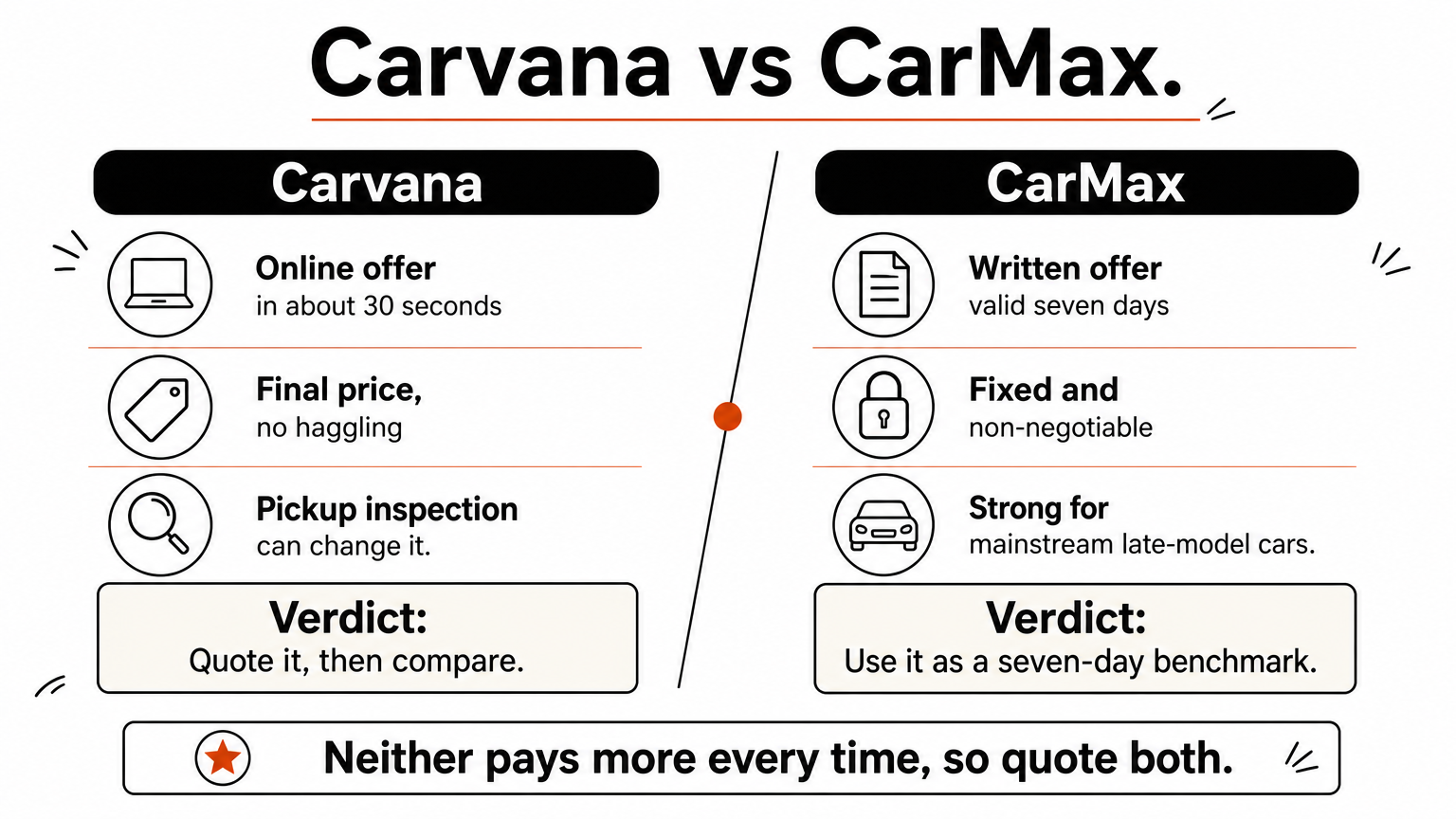
The practical answer is to quote both in the same sitting. CarMax gives you a seven-day written number, and Carvana gives you a fixed number within a minute or so. Together they show you the instant-buyer range before you talk to anyone else.
Which option fits your situation
Match the option to the problem you are solving:
- You need money fast: Car Trackers (same-day wire after pickup), CarMax, or a local dealer.
- You want the maximum price and have time: a private sale, ideally on a paid listing site if the car is worth enough.
- You are exiting a lease: check your lease terms, because some lessors limit third-party buyouts, then get quotes from buyers that handle the title work.
- You owe more than the car is worth: you will need to cover the difference with your lender, so get the payoff figure first.
- You own a rare or modified car: an auction site.
How to raise any offer before you sell
Know your car’s real value
Your first job is to get a realistic number before anyone quotes you. Use a valuation tool from a source like Kelley Blue Book or Edmunds to determine your car’s value, entering your exact trim, mileage, options, and condition. Then check what similar cars are asking in your area, remembering that asking prices are higher than sale prices.
Know the three numbers that matter: what dealers will likely pay, what instant buyers will likely pay, and what a private buyer might pay. The spread between them is the money you are trying to capture.
Know the gap between trade-in value and retail value, because that gap is your negotiating range.
Prepare the car and paperwork
A clean car and complete records raise every kind of offer. Detail the interior, wash the exterior, and fix cheap items such as a burned-out bulb or a cloudy headlight. Do not spend on major repairs, because they rarely pay back in the offer.
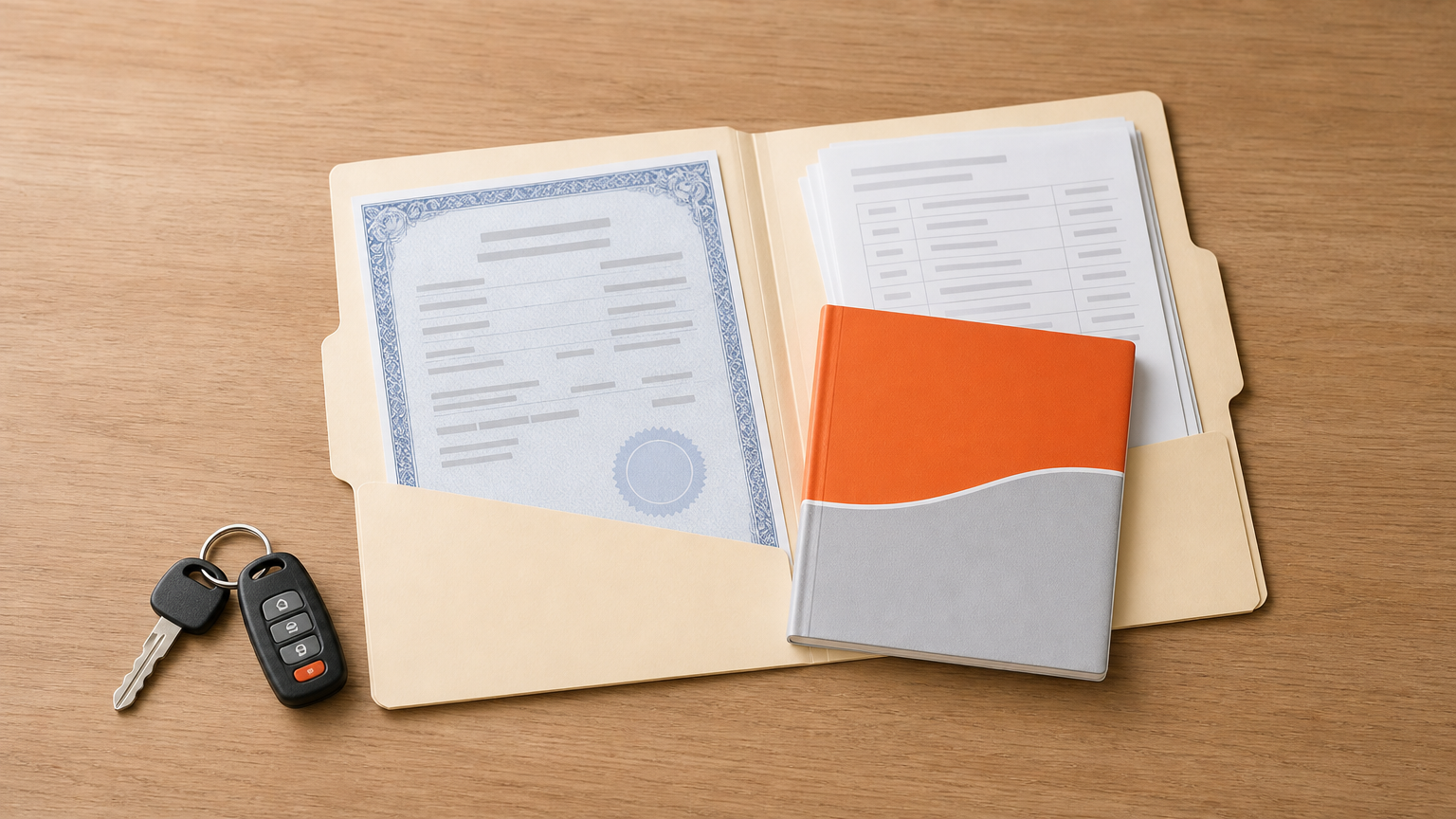
Gather what buyers will ask for, following these tips before selling your car:
- The title, or loan payoff details if a lender holds it.
- Service and maintenance records.
- Both keys or fobs, since a missing key can reduce an offer.
- The owner’s manual and any accessories.
Collect three to five offers in one sitting
Offers move with the market, so gather them on the same day and compare like with like. A sensible set includes one dealer-network quote, one fixed-offer buyer such as CarMax or Carvana, one local dealer, and one remote buyer. Add a private-sale price check by looking at similar listings.
Write each offer and its expiration date in one list. Then take the highest number back to the others and ask them to beat it. With a price-match guarantee on the table, as at Car Trackers, that step is built in.
Time the sale and settle the loan
Timing helps a little, not a lot, so treat the best time to sell a car as a bonus. Demand for used cars often runs stronger in spring, when tax refunds arrive, and shifts by vehicle type, with convertibles favored in summer and all-wheel-drive vehicles in fall. Do not delay a sale for a season if you need the money now, because every month of ownership also costs you depreciation.
If you have a loan, call your lender for a payoff quote before you start, and ask how it releases the title. Buyers who handle the payoff for you save steps. Keep a copy of the signed bill of sale or purchase agreement for your records.
Get the best number, then choose
The most money comes from the buyer who values your car most, and that is usually a private buyer paying retail. Most sellers do better by collecting several offers and letting the best one win, because the time and risk of a private sale can erase the gain. Use CarMax and Carvana as benchmarks, a local dealer if you are buying another car, and an auction only if your car is special.
If you want a dealer-beating offer, you can sell your car without visiting a dealer by starting with a quote from Car Trackers. A 10-minute video appraisal gives you a final offer, there is no obligation, and a competing dealer’s price is something we will match or beat by up to $1,000.
