

In most states, no. The title is the legal proof that you own the car, and a buyer needs it to register the vehicle. So can I sell my car without my title has a practical answer: not until you replace the title, clear the lien on it, or use a state-approved substitute such as a bill of sale. The fix is to find out who holds your title, request a duplicate, use a state alternative if no title can be issued, and then sell to a buyer who can handle the paperwork.
Most people who ask this question do have a title somewhere. It is in a drawer you can’t find, at the bank because of an open loan, or stored as an electronic record you have never seen. Others have a real gap. The car was inherited, the title is in an ex-spouse’s name, or the vehicle is old enough that your state never issued one. Each case has a different fix, and the rules change from state to state, which is why generic advice leaves so many sellers stuck.
This guide gives you a grounding in why the title matters, then four steps in the order you should take them. You will see which buyers accept a car while the paperwork is still moving, and what to keep after the sale. Car Trackers buys cars online through a short video appraisal, and our licensed appraisers handle the paperwork and title transfer, so we know exactly where sales stall.
Why the title matters and when you can skip it
Selling a car without a title is illegal in most states, because the title is the official record of ownership and the document a buyer needs to register the car. A few exceptions exist, but "without the title in hand" is rarely the same as "without a title." Before you do anything else, work out which of the two you are dealing with.
Having no title in hand versus having no title
Most missing-title problems fall into five situations, and each one points to a different first move. Identify your situation first, because a lost paper title and a lien held by your lender are solved in completely different ways.
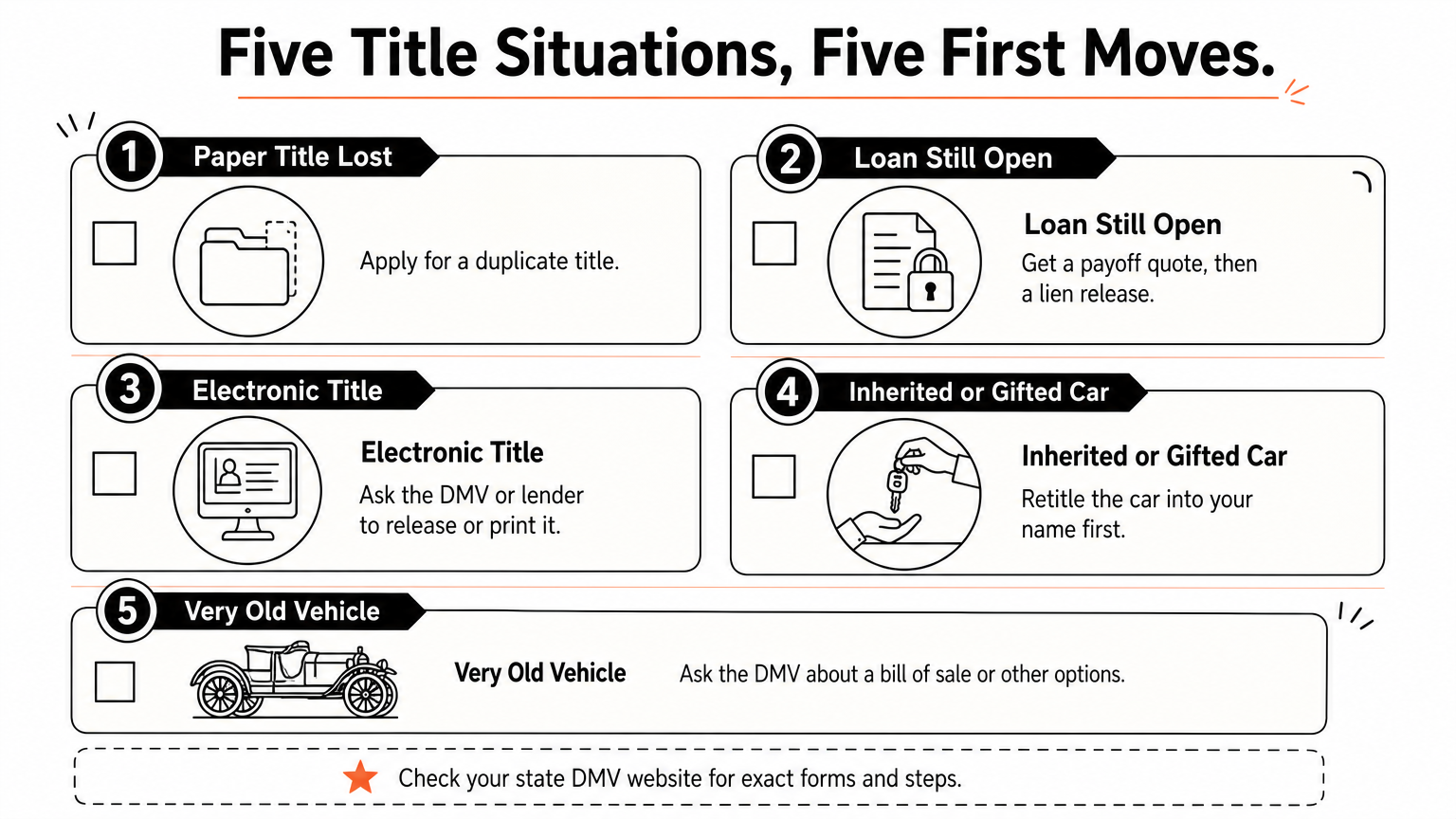
| Your situation | What it means | First move |
|---|---|---|
| Paper title lost, stolen, or damaged | A title exists, but you can’t produce it | Apply for a duplicate title |
| Loan still open | Your lender holds the title or an electronic lien | Get a payoff quote, then a lien release |
| Electronic title (e-title) | The record exists with no paper copy | Ask the DMV or lender to release or print it |
| Inherited or gifted car | The title is in someone else’s name | Retitle the car into your name first |
| Very old vehicle | Your state may never have issued a title | Ask the DMV about a bill of sale or other options |
If you can’t produce a title today, the most likely problem is one you can solve with a form and a phone call.
What goes wrong if you sell without one
The risks fall on both sides of the deal. The buyer usually can’t register the car, which means the sale can collapse or be reversed days later. You also stay exposed, because if the state still lists you as the owner, tickets, tolls, and accident claims can keep landing on you.
A sale with no ownership proof also looks like a stolen-car sale to many buyers, which narrows your pool to cash buyers who offer less. In practice, the consequences look like this:
- The buyer cannot title or register the car and demands a refund.
- You remain the owner of record and receive parking tickets, toll bills, or worse.
- A lender with an unreleased lien can claim the car after the sale.
- A knowingly false claim about the title can create legal trouble beyond the sale.
Step 1. Find out who holds your title
Start by confirming where your title actually is. Check for a lien and an electronic title before you pay for a duplicate, because many "lost" titles were never sent to you in the first place. This step takes one phone call and often saves weeks.
Check for a lien or an electronic title
If you financed the car, your lender may still hold the title, either on paper or as an electronic lien record. Many states now run electronic titling, so you may be searching for paper that never existed. Call your lender, or log in to its portal, and ask three questions: what is the payoff amount, is the title electronic, and how will the lien release reach you?
Here is how a lien works out in a typical sale. Say you owe $6,000 and a buyer offers $9,500. The buyer or dealer pays $6,000 to the lender, the lender releases the lien, and you receive the remaining $3,500. This is a hypothetical, but the mechanics are standard. Ask the lender for a payoff quote that stays valid for a set number of days, so the figure holds while the sale closes.
Check the name on the record
Your name on the title has to match your ID. Look for a married-name change, a typo, or a co-owner you forgot about. If two owners are listed, many states require both signatures to transfer the car, and the word joining the names, such as "and" or "or," can decide that.
If the car was inherited or gifted, you generally can’t sell it until the title is in your name. That usually means filing the DMV’s forms to transfer car ownership with supporting documents, such as a death certificate or probate paperwork for an inherited car. Your DMV’s website lists exactly which ones apply, and this retitling step has to come first.
Do not pay for a duplicate title until you know whether a lender, an e-title, or a name problem is the real obstacle.
Step 2. Request a duplicate title
When you own the car outright and the paper title is gone, the cleanest answer to "can I sell my car without a title" is to replace it. You apply to your state DMV, or its equivalent such as the BMV or MVD, with a form, ID, your VIN, and a fee. Apply to your state agency directly, since private services add fees on top of the same form.
What you need to apply
Requirements differ by state, but the application usually asks for the same core items. Gather them before you start so the DMV does not bounce your request:
- The state’s duplicate or replacement title application, found on the DMV website.
- A government-issued photo ID that matches the owner’s name.
- The VIN, plate number, and current odometer reading.
- A lien release, if a lender was ever listed on the title.
- The fee, which varies by state.
- A notarized signature, in states that require one.
Make sure the address on file with the DMV is current. A duplicate mailed to an old address is a common reason sellers lose another month.
How long it takes and how to keep moving
Processing time depends heavily on the state. Some DMVs print a duplicate at the counter or offer an expedite fee, while mail requests commonly take two to six weeks. Applying online, where your state allows it, is usually the fastest route.
Do not wait idly while the title is in transit. Get offers while you wait, so you know your car’s value and can sell the day the title arrives. If the original paper title turns up after the DMV issues a duplicate, the original is generally no longer valid, so don’t try to use it in the sale.
A duplicate title is the only fix that makes your car fully sellable to anyone, so request it first unless your situation clearly calls for another route.
Step 3. Use a bill of sale if your state allows it
A bill of sale does not replace a title by itself. It works only where your state accepts it as proof of ownership, which is mostly for older vehicles or alongside another state process. Confirm with your DMV that a bill of sale is enough before you rely on one, because in many states it is not.
What a bill of sale needs to say
Where it is accepted, a bill of sale should record the sale date, price, vehicle details (year, make, model, VIN, mileage), buyer and seller names and addresses, and both signatures. Some states supply a required form, so check for one first. If your state has no form, this template covers the standard items. Copy it, fill in the brackets, and add any wording your DMV requires:
BILL OF SALE

Date of sale: [MM/DD/YYYY]
Sale price: $[amount]

Seller: [full legal name]
Address: [street, city, state, ZIP]
Driver's license no.: [number]

Buyer: [full legal name]
Address: [street, city, state, ZIP]

Vehicle: [year] [make] [model]
VIN: [17-character VIN]
Odometer reading: [miles]

Title status: Seller does not have the title in hand because
[reason, such as lost, lien payoff in progress, or no title issued
for this vehicle]. The seller states that he or she is the lawful
owner and has the right to sell the vehicle. Sold as is.

Seller signature: ______________  Date: ________
Buyer signature: ______________  Date: ________
State alternatives, notaries, and honesty with the buyer
Some states offer other routes when no title can be issued. These include a bonded title, where you buy a surety bond and then apply for a title, and an abandoned-vehicle or mechanic’s lien process. Others issue the buyer a temporary permit while retitling is under way. These routes are slower and vary widely, so treat your DMV’s website as the authority.
Have the bill of sale notarized even if your state does not require it, since a notary’s witness adds credibility. Then tell the buyer upfront that you have no title in hand and why. Never write that a title was "lost" if the truth is a lender holds it. A buyer who learns that later will walk away, and a false statement on paperwork can cause real legal trouble.
A bill of sale supports a sale where your state accepts it, but on its own it will not replace a title.
Step 4. Pick a buyer and finish the paperwork
The right buyer depends on how far along your title is. If the duplicate has arrived, almost anyone can buy. If it hasn’t, only some buyers can work with a car that has a lien or a pending title. Choose with that in mind, then close the sale in a way that protects you.
Which buyers take a car while the title is pending
Private buyers carry the most risk for a seller with no title. They can’t register the car without one, and most will not pay for a car they can’t title. Dealerships, salvage yards, and online buyers each handle missing paperwork differently:
| Buyer | What they typically need | Speed | Price outlook |
|---|---|---|---|
| Private buyer | The signed title, no exceptions in most states | Slowest | Highest on paper, often falls through |
| Dealership | Registration, ID, and lien details so they can verify ownership and pay off the lender | Fast | Fair, varies by dealer |
| Junkyard or salvage yard | ID, registration, and often a bill of sale or ownership affidavit, depending on state | Same day | Lowest |
| Online buyer such as Car Trackers | Video appraisal, then licensed appraisers manage the paperwork and title transfer | Same-day offer | Beats most dealer offers by up to $1,000 |
Junkyards and salvage yards sometimes accept older or damaged cars with only alternative documents, but state rules differ, so ask before you tow the car there. With Car Trackers, the video appraisal takes about 10 minutes, the offer is free with no obligation, and payment is by same-day wire once the car is picked up. That makes it a good way to lock in a real number while your duplicate title is in the mail. Ask any buyer which documents your state requires before you schedule pickup.
Close the sale and protect yourself
Once you have a buyer, finish the sale in a way that leaves no loose ends. Notify the DMV of the sale right away. Deadlines vary by state, and some are as short as five days. Until the state updates its records, you can be held responsible for the car.
Use this checklist at closing:
- Confirm payment has cleared before the car leaves your hands.
- Keep copies of the bill of sale, lien release, and any DMV forms.
- Photograph the odometer and the signed paperwork on the day of sale.
- File your state’s notice of sale or release of liability.
- Remove plates if your state requires it, then update or cancel your insurance.
The sale isn’t finished when the car leaves your driveway. It’s finished when the state shows you are no longer the owner.
Get the paperwork right, then sell
You usually can’t sell a car legally without the title, but the missing title is rarely the dead end it feels like. Find out whether a lender, an e-title, or a name mismatch is behind it, then request a duplicate. If no title can be issued, ask whether your state accepts a bill of sale or a bonded title. Then pick a buyer who can work with your situation and file your notice of sale quickly.

You don’t need to wait for the paperwork to learn what your car is worth. If you want a number now, get a free, no-obligation instant car offer from Car Trackers, and let a licensed appraiser walk you through the next steps by video call.
