

If you search for cash for cars California, you will find two very different things mixed together. One is the private market, where buyers and removal services pay you for a used, damaged, or junk car. The other is a state program, and people often confuse the two. Knowing which one fits your situation saves you time and phone calls.
Here is the short answer. Cash for cars means a company buys your vehicle and pays you, usually within days, with no need to list it yourself. The state’s Consumer Assistance Program, often called Cash for Clunkers, is different. It pays a fixed retirement amount to eligible owners who scrap a car that failed smog, and it has income and vehicle requirements.
This article explains how both options work, who qualifies, and what to expect from each step. We also cover how to compare offers, so you know when a quote is fair. At Car Trackers, we buy cars remotely through a 10-minute video appraisal, so we will point out where that route beats a junkyard or dealer.
Why cash for cars in California matters
An aging car gets expensive fast here
California has more registered vehicles than any other state, and it enforces some of the strictest emissions rules in the country. Most vehicles need a smog check every two years, and a failed test can block your registration until the car is repaired. On an older car, that repair bill can easily exceed what the car is worth.
Registration fees, insurance, and parking keep adding up while the car sits unused. If you park it for good, you still have to file Planned Non-Operation with the DMV to stop the registration clock. Many owners find it cheaper to sell than to keep paying for a car they no longer drive.
A car that costs more to fix than it is worth is a liability, and selling it early limits your loss.
Your options are not interchangeable
People searching for cash for cars in California usually want one of four things. Each route fits a different car and a different owner, so it helps to see them side by side.
| Option | Best for | Main catch |
|---|---|---|
| Local cash-for-cars buyer or junk removal | Non-running or wrecked cars | Offers vary widely, so you need several quotes |
| Remote buyer such as Car Trackers | Running cars, including leases and upgrades | You need a smartphone for the video appraisal |
| State vehicle retirement (Consumer Assistance Program) | Income-eligible owners whose car failed smog | Income limits, and the car is scrapped |
| Private sale | Cars in good condition | You handle buyers, paperwork, and usually the smog certificate |
Notice that the state program pays only if you qualify, while a cash buyer pays based on the car’s value. Treat them as separate decisions. You can check your eligibility for one and still collect offers for the other.
The paperwork is where sellers get burned
The sale price is only half the story. After you hand over the car, you must submit a Notice of Transfer and Release of Liability to the DMV within five days. Skip it and the old car’s parking tickets, toll charges, and even accident liability can land on you.
Selling to a private party also usually means you must supply a valid smog certificate, and that is a real cost on a car that already struggles to pass. A buyer who handles the title transfer and paperwork removes most of that risk. That is why the way you sell matters as much as the number you are offered.
How to sell your car for cash in California
Selling for cash comes down to three moves: prepare your documents, collect real offers, and close the sale cleanly. Here is how cash for cars California buyers usually work, and what you should do at each step.
Gather your documents first
Start with the California certificate of title, often called the pink slip. If you lost it, request a duplicate from the DMV before you sell, because most buyers cannot finish the transfer without it. If you still owe money on the car, ask your lender for a payoff amount, since the buyer has to clear that lien.
Have these required documents ready before you call anyone:
- Title, or your lender’s payoff letter
- Current registration
- Government photo ID
- All keys and fobs
- Service records, if you have them
Collect offers and compare them
Next, ask for at least three quotes on the same day so each one reflects the same market. Give every buyer identical, honest details: mileage, damage, warning lights, and whether the car runs. Changing the story between calls makes offers impossible to compare.
With Car Trackers, you submit your vehicle details online, then join a 10-minute video call where a licensed appraiser looks over the car through your phone camera. The final offer comes instantly, and there is no cost or obligation if you decide to walk away.
Close the sale and get paid
Finally, read the purchase agreement before you sign. Check that the price, the buyer’s name, and the odometer reading match what you were told. A legitimate buyer handles the title transfer and explains each form.
Payment timing matters more than most sellers expect. Car Trackers sends a same-day wire when the car is picked up, which is the standard you should hold other buyers to.
Never hand over the keys until the money has cleared or the wire is confirmed.
Once the car is gone, file your release of liability with the DMV right away so the car is no longer tied to you.
How to qualify for the state vehicle retirement program
Qualifying for the state’s Consumer Assistance Program (CAP), run by the Bureau of Automotive Repair (BAR), is much stricter than selling to a buyer. Treat it as a hardship program, not a general version of cash for cars California services. Amounts and income limits change, so confirm the current numbers on the BAR website before you apply.
Who and what qualifies
The program has two tests, one for you and one for the car. On the income side, your household income must fall at or below the program’s limit, which has recently been set at 225% of the federal poverty level. On the vehicle side, the car must have failed its most recent smog check and be registered in California.
Here is the typical checklist:
- The car failed its biennial smog inspection
- It has a current California registration
- It runs and can be driven to the dismantler under its own power
- Your household income is within the limit
- You are the registered owner
That last point about driving matters. A car that no longer starts usually does not qualify, which is exactly the situation where a junk removal buyer is the better fit.
How the process works
You apply through BAR, prove your income, and wait for approval. If approved, you take the car to a participating dismantler, who verifies it and retires it. The payment is a fixed amount, not a negotiated price, so a car worth more on the open market is usually better sold.
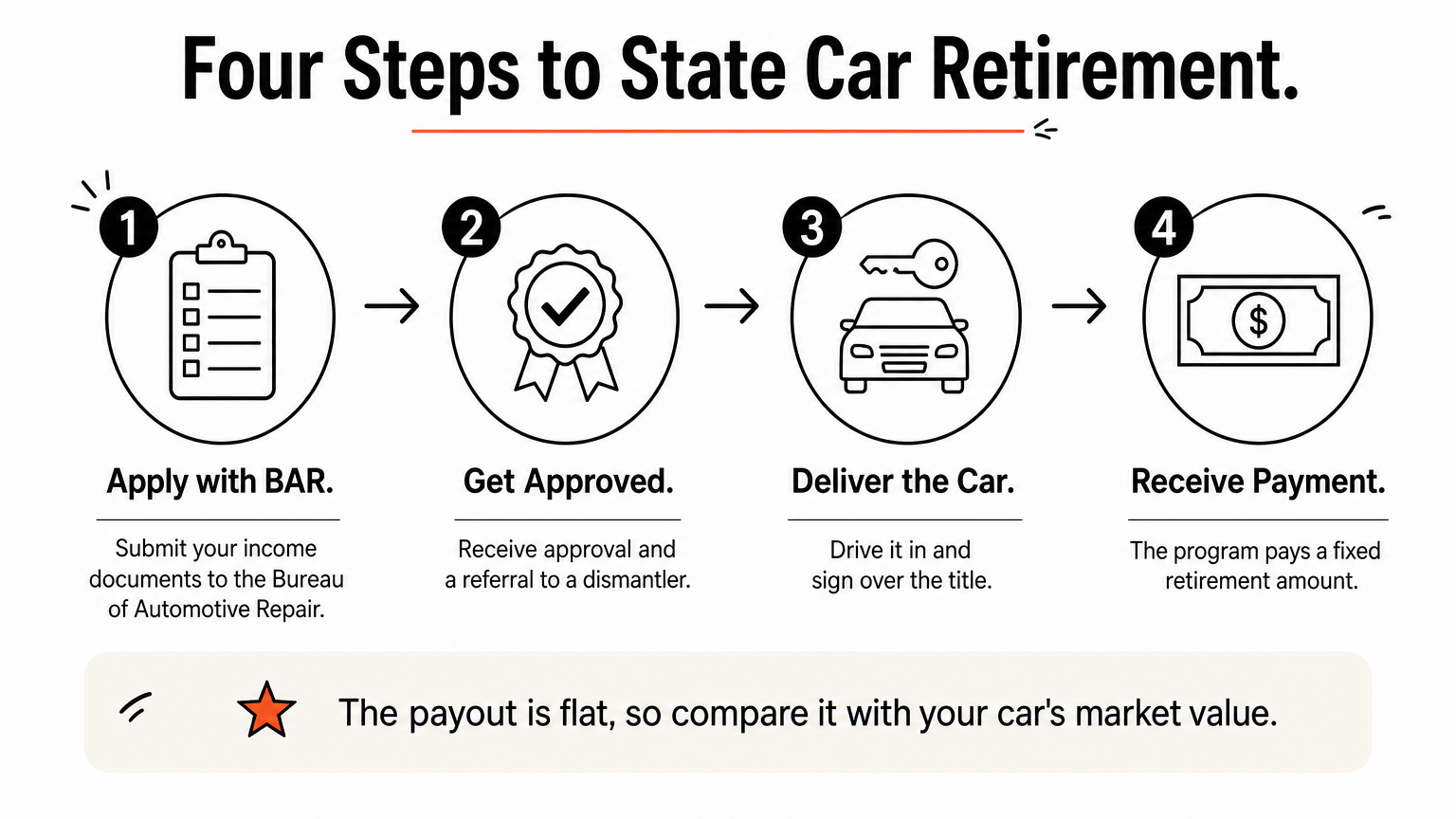
- Apply with BAR and submit income documents.
- Get approval and a referral to a dismantler.
- Deliver the car and sign over the title.
- Receive the retirement payment.
The retirement program pays a flat amount for a scrapped car, so it only wins when your car is worth less than that payout.
Run the math before you commit. If your car still runs and has real resale value, a quote from a remote buyer may pay more, and you keep the option of declining. If it truly failed smog and you meet the income limit, apply to the program and request a cash quote in parallel. Then pick the higher number.
How to compare cash offers and avoid common pitfalls
Compare what you keep, not the headline number
A high quote means little if the terms behind it fall apart. When you line up cash for cars California offers, compare what ends up in your bank account and what happens on pickup day. Ask every buyer the same four questions and write down the answers.
| Question | Good answer | Red flag |
|---|---|---|
| Is towing or pickup free? | Yes, stated in writing | A fee is deducted at pickup |
| Can the price change later? | Only if the car differs from your description | "We’ll adjust it when we see it" |
| How and when do I get paid? | Wire or cashier’s check at pickup | Payment "within 30 days" |
| Who handles the title transfer? | The buyer, with your release of liability filed | You are told to skip the paperwork |
Spot the red flags early
Watch for the bait and switch. A buyer quotes a big number over the phone, then knocks hundreds off once the tow truck arrives, claiming hidden damage. You can limit this by describing the car honestly up front and asking for the quote in writing or by text.
The best offer is the one that is still the same number when the tow truck shows up.
Verify that the buyer is real. Licensed dealers and dismantlers hold a DMV-issued license, so ask for the license number and check it. Be wary of anyone who wants a deposit, a "processing fee," or a signed blank title.
Use one offer to beat another
Once you hold a written quote, put it to work. Car Trackers has a price-match guarantee and will beat a competing dealer offer by up to $1,000, so a rival’s number gives you leverage instead of just a comparison.
Keep every quote in one place, with the buyer’s name, the date, and the conditions attached. That record makes the final choice simple and protects you if a number changes later.
Common situations and what to do in each
Most sellers fall into one of three situations. Find yours, then follow the matching steps.
The car failed smog
A failed test leaves you three choices, and the right one depends on your income and the car’s condition.
- Repair it if the fix costs far less than the car’s value.
- Apply to CAP if you meet the income limit and the car still drives.
- Sell it as is to a licensed dealer or dismantler.
Selling as is often wins because those buyers typically don’t require a smog certificate from you. Confirm that with the buyer first, since the smog cost is what pushes many owners toward cash for cars California services in the first place.
The car won’t start
Cars that can’t move under their own power rarely qualify for the state program, so a junk removal buyer is usually your best route. Ask for free towing in writing, and refuse any fee that appears at pickup.
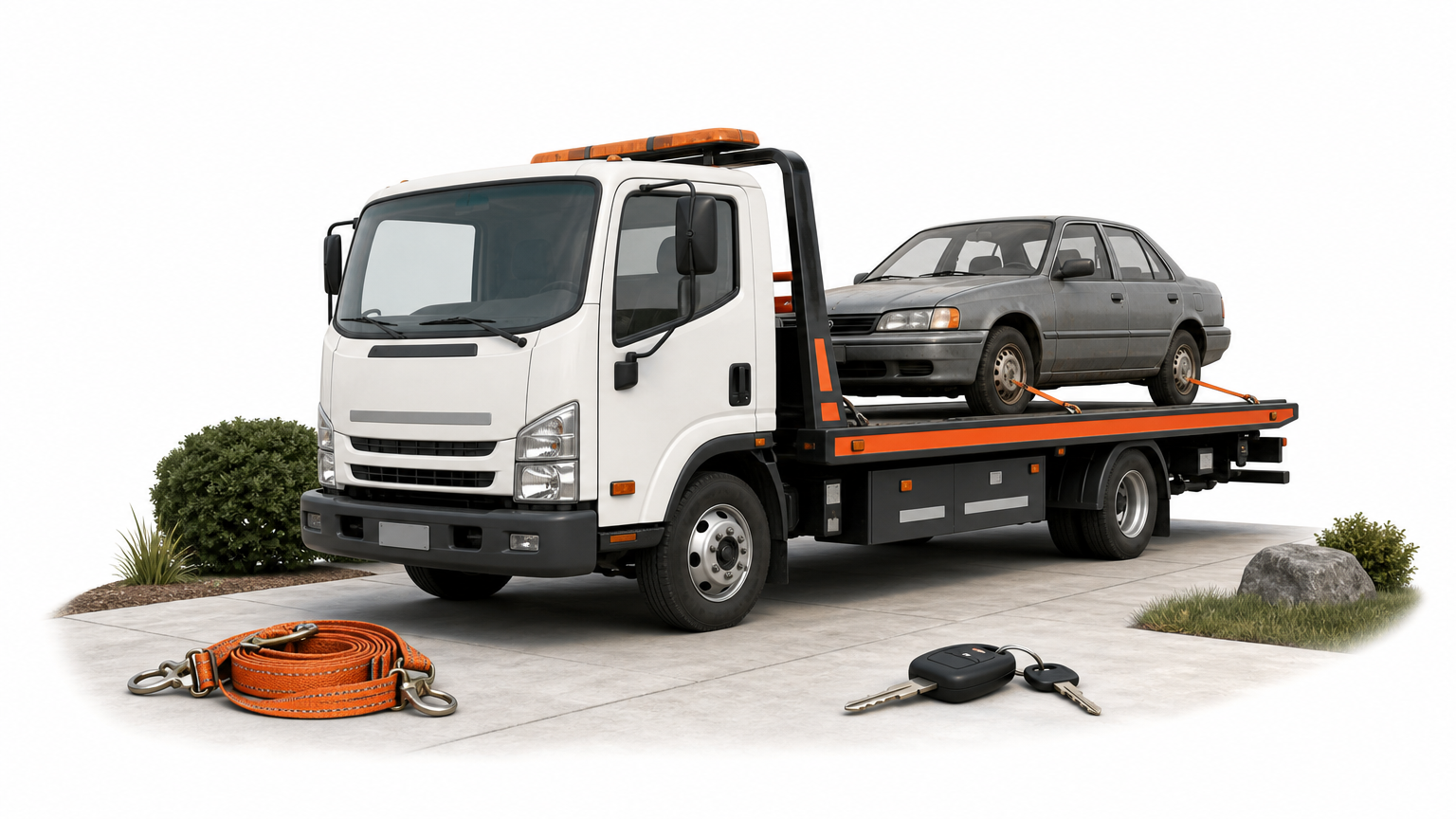
Expect a lower number than a running car would bring, because the buyer is pricing parts and scrap weight. Collect three quotes anyway. The spread between buyers on the same wreck can be wide.
You still owe money or have a lease
Start with the payoff amount from your lender. If an offer is higher, you keep the difference. If it falls short, you pay the gap to close the loan.
Get the payoff number before you take any offer, because it sets your floor.
Leases add one step. Ask your leasing company whether it accepts a third-party buyout, since some do not. Car Trackers works with owners getting out of a lease or upgrading, and our licensed appraisers manage the paperwork with the lienholder so you aren’t chasing forms.
Picking the right option for your car
Cash for cars California comes down to one question: what shape is your car in? If it failed smog, still drives, and you meet the income limit, the state retirement program is worth a look. If it won’t start, a junk removal buyer with free towing in writing is the practical choice.
Most running cars are worth more on the open market than a flat retirement payout. Whatever you choose, get at least three written quotes, confirm who handles the title transfer, and file your release of liability with the DMV within five days.
Ready to see what your car is worth? Get your instant offer from Car Trackers, finish a 10-minute video appraisal from your phone, and receive a same-day wire when we pick up the car. It costs nothing and carries no obligation, so you can hold it up against every other quote.
