

So you’re asking how do I sell my car in California and you want to do it right, not just fast. Maybe you’ve heard horror stories about sellers getting stuck with parking tickets or toll violations because the title transfer never got filed. Or you’ve spent a weekend fielding lowball offers from strangers on Craigslist. Either way, California has specific rules, and skipping a step can leave you legally responsible for a car you no longer own.
This guide walks you through exactly what the DMV requires, from the Notice of Release of Liability to signing over the title correctly, whether you’re selling to a private buyer or a dealership. You’ll know which forms to file, when to file them, and how to protect yourself from liability the moment the sale closes. We also cover the paperwork differences between a private sale and a dealer transaction, since the process and your legal exposure aren’t identical.
If you’d rather skip the DMV lines and buyer negotiations altogether, we’ll also show you how a same-day online sale works, including a free video appraisal and instant offer, so you can compare both paths before deciding which one fits your timeline.
What you need to know before selling a car in California
Before you post an ad or call a dealer, understand that California treats car sales as a legal transfer of liability, not just a handshake deal. Learning how to transfer car ownership through the DMV is not optional, and if you skip it, you stay on the hook for parking tickets, toll violations, and even accidents the new owner causes. Knowing the rules upfront saves you from a mess that shows up months after you thought the sale was done.

Title transfer and the Release of Liability
Every seller in California needs to file a Notice of Release of Liability (REG 138) with the DMV within 5 days of the sale. You can file it online through the DMV’s website even if the buyer hasn’t finished their paperwork yet. This single form is what protects you if the new owner racks up citations or gets into an accident before registering the car in their name.
File your Release of Liability the same day you hand over the keys, not the same week.
You’ll also need to sign over the certificate of title to the buyer. If your title is lost, order a duplicate from the DMV before you start showing the car, since selling a car without a title can delay or kill a sale. If you still owe money on the car, you’ll need to work with your lender to either pay off the loan or arrange a payoff at the time of sale, which typically means the buyer’s funds go to the lienholder first.
Smog check and registration requirements
Most gas-powered vehicles in California need a valid smog check before selling, unless the car is less than 4 years old, is a diesel vehicle model year 1997 or older, or is fully electric. Check the California DMV smog requirements page to confirm whether your car qualifies for an exemption. If it doesn’t, get the smog check done before you list the car, since most buyers and all dealers will expect it.
Here’s a quick reference for what typically applies:
| Situation | Smog check required? |
|---|---|
| Gas vehicle, 4 years old or newer | No |
| Gas vehicle, older than 4 years | Yes |
| Diesel, model year 1998 or newer, under 14,000 lbs GVWR | Yes |
| Diesel, model year 1997 or older | No |
| Fully electric vehicle | No |
| Hybrid | Usually yes, check current DMV rules |
Registration also matters. If you need to sell a car with expired registration, renew it or disclose that clearly to the buyer, since an unregistered car is harder to sell and can complicate the DMV filing on both ends.
Selling to a private party versus a dealer
Selling privately means you handle every form California asks of a seller yourself: the title, the REG 138, the bill of sale, and often the smog certificate. Selling to a dealer, or to a buyer like Car Trackers, shifts most of that paperwork burden onto licensed staff who process title transfers daily and know exactly what the DMV expects. That difference alone is worth weighing before you decide how do I sell my car in California the traditional way versus a faster, guided route.
Step 1. Decide how you want to sell your car
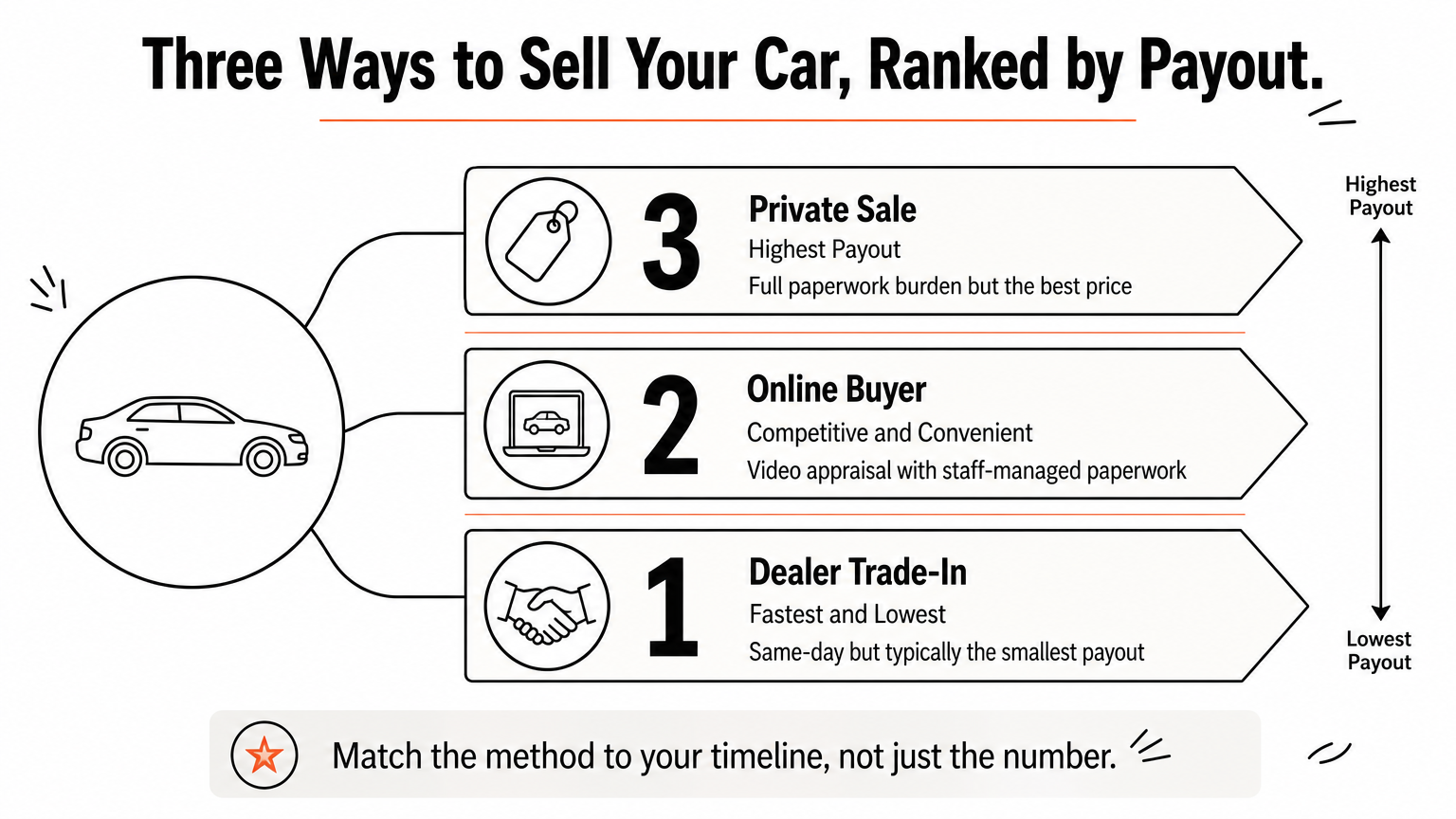
Before you touch any paperwork, pick your selling method, since it determines everything else: how much you’ll spend on prep, how long the sale takes, and how much liability risk you carry in the meantime. Most California sellers choose between three routes, and each one has real tradeoffs you should weigh against your timeline and how much hassle you’re willing to tolerate.
Private sale, dealer trade-in, or online buyer
Selling privately rather than trading in usually nets the highest price, but you’re responsible for advertising, screening buyers, negotiating, and filing every DMV form yourself. A dealer trade-in is fast and paperwork-light, but dealers typically lowball you because they need margin to resell the car. An online buyer compared to a private sale, like Car Trackers, sits in between: you get a real appraisal, licensed staff handle the title transfer and Release of Liability, and payment happens the same day the car gets picked up.
The fastest sale isn’t always the best one, but the one with the least paperwork risk usually is.
Here’s how the three compare on the factors that actually matter:
| Method | Typical payout | Your paperwork burden | Time to close |
|---|---|---|---|
| Private sale | Highest | Full (title, REG 138, bill of sale, smog) | Days to weeks |
| Dealer trade-in | Lowest | Minimal | Same day |
| Online buyer (video appraisal) | Competitive, often matches or beats dealer offers | Minimal, staff-managed | Same day |
Matching the method to your situation
Consider your car’s condition and your own schedule before committing. If your vehicle needs cosmetic work or has a lien still attached, a guided sale through a licensed buyer avoids the headache of explaining that to a stranger off Craigslist. If you have time to spare and want top dollar, a private sale still makes sense, just budget extra time for buyer no-shows and financing delays.
Selling remotely also solves a problem private sellers hit constantly: meeting strangers to test-drive a car. Car Trackers’ video call appraisal replaces that step entirely, so you can sell your car from home without letting unknown buyers into your garage or driveway.
Step 2. Gather your title, smog certificate, and other paperwork
Getting your documents together before you list the car saves you from scrambling later, especially if a buyer wants to close within days. Missing paperwork is the number one reason private sales fall through in California, so treat this step as non-negotiable rather than something you’ll handle after you find a buyer.
Building your paperwork checklist
Start with the title itself, since nothing else matters if you can’t produce it. Order a duplicate from the DMV right away if yours is lost, damaged, or still sitting with a lienholder, because that process can take a couple of weeks. Beyond the title, there are required documents to sell a car in California for a legal transfer:
- Certificate of title, signed and dated by you as the seller
- Smog certification, unless your vehicle qualifies for an exemption
- Bill of sale, listing price, date, odometer reading, and both parties’ signatures
- Notice of Release of Liability (REG 138), filed within 5 days of the sale
- Odometer disclosure statement, required for vehicles under 10 years old
- Lien payoff letter, if you financed the car and still owe a balance
A car with an incomplete paperwork stack isn’t ready to sell yet, no matter how clean the engine bay looks.
Handling liens and loan payoffs
Contact your lender before you accept any offer if there’s still a loan on the vehicle. Ask for a payoff quote good through your expected sale date, since interest accrues daily and an outdated figure can leave you short at closing. Many lenders will release the title directly to a buyer’s lender or a licensed dealer once the payoff clears, which is exactly how transactions with a buyer like Car Trackers typically work: their staff coordinates directly with your lienholder so you’re not stuck driving to a bank branch.
Double-check your smog certificate timing too, since California only accepts one dated within 90 days of the sale. If yours has expired, schedule a new test before you list the car, not after a buyer asks for it. Sellers who show up with a complete file close faster and negotiate from a stronger position, whether they’re dealing with a private buyer or a licensed appraiser.
Step 3. Price your car and find a buyer
Once your paperwork is in order, the next question is what your car is actually worth and where to list it. Guessing at a price either scares off serious buyers or leaves money on the table, so pull real data before you post anything.
Setting a realistic price
Start by determining your car’s value and setting the right selling price using at least two independent sources, since a single number rarely tells the whole story. Sites like Kelley Blue Book and Edmunds give you a trade-in range and a private-party range, and the gap between them tells you how much extra work a private sale will actually earn you. Factor in mileage, accident history, and any mechanical issues honestly, because buyers and appraisers alike will catch discrepancies during inspection.
Price your car for the market it’s actually in, not the market you wish it was in.
California’s used car demand shifts by region too. Coastal cities like Ventura or Oceanside often see higher demand for fuel-efficient and electric vehicles, while trucks and SUVs move faster inland. Adjust your asking price with that local context in mind rather than relying purely on a national average.
Where to find buyers
Every path to a buyer comes with its own tradeoffs, and knowing them upfront keeps you from wasting a week on a channel that doesn’t fit your car:
- Classifieds and marketplace apps reach the widest pool of private buyers but require screening, test drives, and negotiation
- Local dealerships offer speed but rarely match private-party pricing
- Online buyers like Car Trackers combine a free video appraisal with an instant offer, so you skip the back-and-forth entirely
Getting multiple quotes matters if you want the best number, regardless of which route you pick. Submit your details to two or three sources, compare the offers side by side, and use the highest legitimate one as leverage. If you’re wondering how to sell your car fast in California without gambling on a stranger showing up with cash, a same-day online offer removes most of the uncertainty that private sales carry.
Step 4. Complete the sale and transfer the title with the DMV
Closing the deal is where most private sellers get nervous, and rightly so, since a mistake here is what leaves you legally tied to a car you no longer drive. Once you’ve agreed on a price, the goal is simple: get paid securely, sign over the title correctly, and file your paperwork with the DMV before you hand over the keys for good.
Finalizing payment and signatures
Accept only a safe payment method when selling your car, one you can verify before the buyer leaves with the vehicle. Cashier’s checks can be forged, so call the issuing bank to confirm funds, or ask for a wire transfer you can watch clear in real time. Sign the certificate of title exactly as your name appears on the front, fill in the odometer reading, and have the buyer sign as well. Complete the bill of sale together, keeping a copy for your own records in case a dispute comes up later.
Never hand over the keys before the payment has actually cleared your account.
Filing your Release of Liability and closing paperwork
File the Notice of Release of Liability (REG 138) with the DMV the same day, either online or by mail, so there’s a timestamped record that you’re no longer responsible for the vehicle. This step matters more than sellers realize: without it, you’re still the registered owner in the DMV’s system, which means any ticket or accident the buyer causes can land back on you.
Here’s the closing checklist to run through before the buyer drives away:
- Confirm payment has cleared, not just been received
- Sign the title with matching name and date
- Hand over the smog certificate and bill of sale copies
- File REG 138 online or by mail that same day
- Remove your license plates if you’re not transferring them to a new vehicle
- Cancel or transfer your insurance policy on the car
If you sold through a licensed buyer like Car Trackers, this entire step is handled for you. Their appraisers manage the title transfer, coordinate any lien payoff, and file the DMV paperwork directly, so you’re not the one racing to a mailbox or DMV counter to protect yourself from liability. Whichever route you took to get here, don’t consider the sale finished until you have written confirmation that the transfer went through.
Wrapping up your car sale in California
Selling a car in California comes down to two things: protecting yourself legally and getting a fair price. Getting your title transfer and Release of Liability filed correctly matters just as much as finding the right buyer, since one missed form can leave you liable for someone else’s parking tickets months later. Handling everything through a private sale gives you control, but it also means you own every step of the paperwork.
If that sounds like more hassle than you want, you don’t have to choose between speed and doing it right. A guided process still gets you a fair number, a clean title transfer, and same-day payment without the DMV lines or stranger negotiations. When you’re ready to skip the guesswork, sell your car in California with Car Trackers for a free instant offer, and see how a same-day, video-appraised sale compares to going it alone.
