

If you typed sell my car without the title into Google, the honest answer is this: in most states you can’t complete a legal sale without one, but you can usually close the gap in days or weeks. The right fix depends on why the title is missing. If it is lost or damaged, order a duplicate. If you still owe money, get the lender’s release. If the car was never titled in your name, look at a bonded or alternate title. If the car is scrap, a salvage yard may take it. If it is an old project car, a documented private sale may work where your state allows it.
The problem goes beyond paperwork. Without a title, a buyer usually can’t register the car, many buyers walk away, and you can stay on the hook for tickets, tolls, or worse if the car never leaves your name. This article lays out five legal routes, ordered from cleanest to most limited. For each one you get how it works, who it suits, and what it costs in money and time. Rules differ by state, so confirm the details with your own DMV before you act.
We built Car Trackers around remote car sales, and our licensed appraisers handle title transfer paperwork for sellers, so we know where these deals stall. A clean title is what makes a fast sale possible, which is why the fixes below come first.
1. Order a duplicate title from your DMV
If the title is lost, stolen, or damaged and it is in your name, a duplicate title is the cleanest fix. Once it arrives, you sell the car like any other, to any buyer, with no discount for missing paper.
A duplicate title turns a problem sale into a normal one.
How it works
Your state DMV issues the duplicate, usually online, by mail, or at a counter. Expect to follow these steps:
- Gather your photo ID, the VIN, your plate number, and your registration.
- Fill out your state’s duplicate title application.
- Pay the fee listed on your DMV’s website.
- Wait for the new title, then sign it over to the buyer.
Check first whether your state issues electronic titles. If it does, the record may exist digitally and you only need the DMV to print it. Also note that a title with an altered odometer reading is usually rejected, so a replacement is the only fix in that case.
Who it suits, cost, and timing
This route suits any owner whose name is on the title and who can prove who they are. Fees differ by state and are usually modest, so read your DMV’s fee page. Processing and mailing time also differ, so order the duplicate before you list the car, not after you find a buyer. If the car was never titled to you, skip to option 3.
2. Get the title released by your lender
If you still owe money, your lender probably holds the title, and paying off the loan gets it released. You can sell the car before that happens if the buyer’s payment goes straight to the lender.
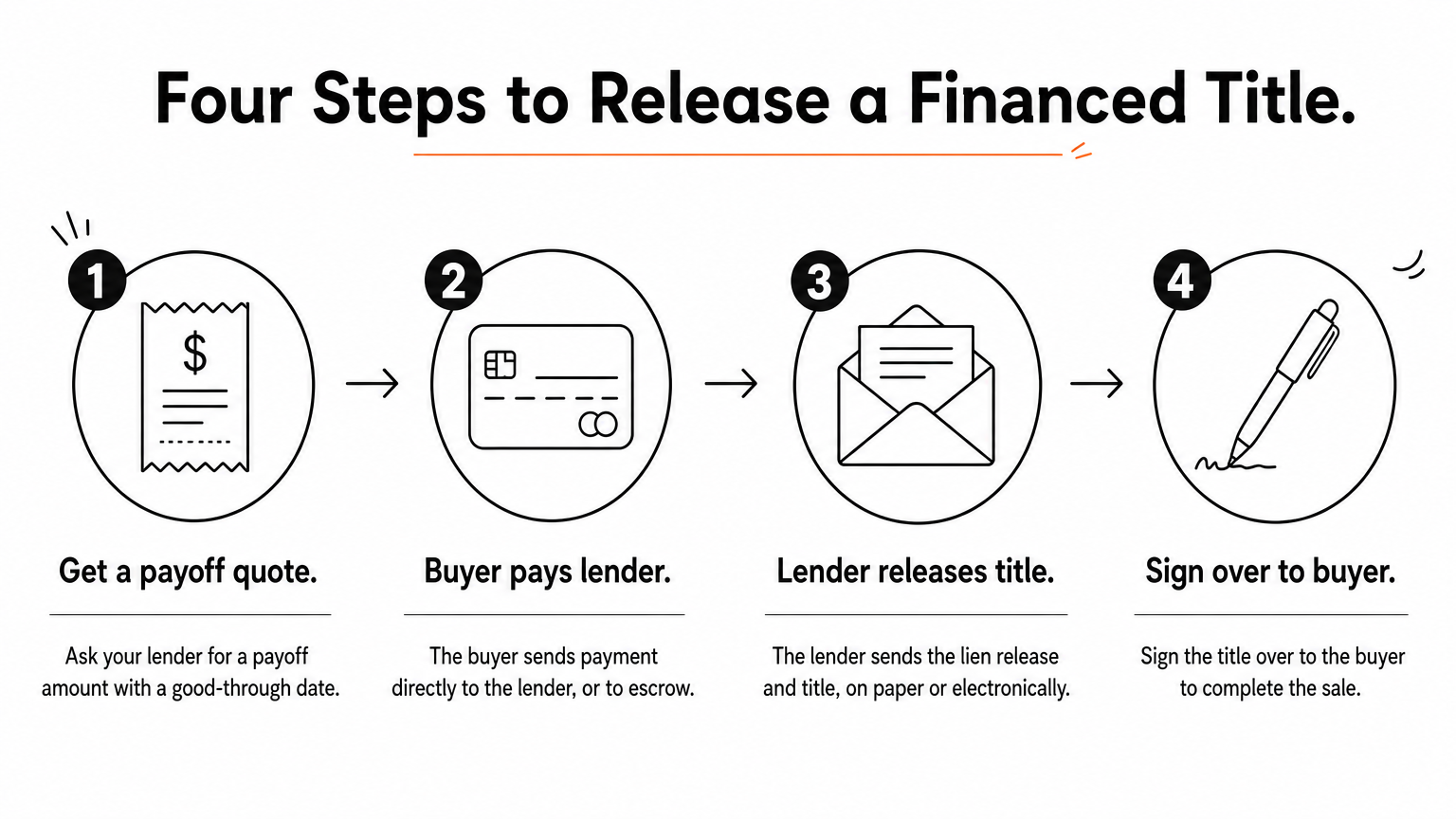
With a loan, the title is not missing. It is waiting on a payoff.
How it works
Most lenders will not release a title until the note is paid. The usual sequence looks like this:
- Ask the lender for a payoff quote with a good-through date.
- Have the buyer pay the lender directly, or meet at the lender’s branch. An escrow service also works.
- The lender sends the lien release and title, on paper or electronically.
- Sign the title over to the buyer.
Dealerships handle this routinely, which is why a trade-in or dealer sale is often the smoothest way to sell a financed car.
Who it suits, cost, and timing
This suits anyone with an active loan. Your cost is the payoff balance. For example, if a buyer pays $14,000 and your payoff is $9,500, the lender gets $9,500 and you keep $4,500. If the car is worth less than the loan, you cover the difference. Release times vary by lender and by state, and electronic title states tend to move faster, so ask for the timeline up front.
3. Apply for a bonded or alternate title
When you can’t get a duplicate because the title was never in your name or the ownership chain is unclear, your state’s alternate titling process can create a valid title. A bonded title is the most common version, and it is also how people fix the problem when they bought a car without a title and want one.

If a duplicate is impossible, a bonded title is the legal way to build ownership from scratch.
How it works
Each state sets its own routes. These are the common ones:
| Situation | Route | What to expect |
|---|---|---|
| Lost title, no proof of ownership | Bonded title | You buy a surety bond, then the state issues a title in your name |
| Car left with you, owner gone | Abandoned vehicle title | The state uses the VIN to contact the last owner, with certified notices |
| Unpaid repair bills at your shop | Mechanic’s lien title | You document the unpaid work and file the lien |
| Car predates your state’s titling rules | Bill of sale | Some states did not issue titles until as late as 1975 |
A bond usually covers a multiple of the car’s value, and you pay a premium that is a fraction of that amount.
Who it suits, cost, and timing
This is for owners and buyers with no paper trail and no lender. It is the slowest route, often weeks or months, and you pay the bond premium plus DMV fees. Abandoned vehicle claims move slowest because of the notice periods. Start by asking your DMV which alternate options it offers for your situation.
4. Sell to a salvage yard, junkyard, or dealer
Salvage yards and junkyards are the most flexible buyers for a car with no title, and some will take it with just your ID and registration. Which documents they accept depends on your state and on the car’s age and condition.
For a scrap car with no title, call yards first and ask what paperwork they need.
How it works
Treat this as a document-gathering exercise, not a quick drop-off:
- Call three or four yards and ask exactly what they require for a no-title car.
- Ask whether towing is free and get the price quote in writing.
- Bring photo ID, registration, and the VIN, and sign a bill of sale.
- Follow your state’s rule on removing plates.
- Notify your DMV that you sold the car.
Licensed dealers are the pickiest. Most want a title or a lender payoff path before they make an offer, and some will say outright that they can’t take the car. Online cash-for-junk-car buyers follow the same rules, so ask them the same questions.
Who it suits, cost, and timing
This suits non-running, older, or low-value cars where a repair or title fix costs more than the car is worth. Payment is usually same-day cash, but the price reflects scrap weight and parts, a fraction of retail value. Be wary of any buyer who skips all paperwork. Without a record of the transfer, you can stay legally tied to the car.
5. Sell to a private buyer with a bill of sale
A private sale with no title only makes sense where your state allows it, mainly for older vehicles exempt from titling and for parts or project cars. Full disclosure to the buyer is not optional.
Never hide a missing title. Put it in writing and let the buyer decide.
How it works
A notarized bill of sale is your core document. Make sure it includes:
- Sale date and price
- Year, make, model, VIN, and mileage
- Buyer and seller names, addresses, and signatures
- A plain statement that the car is sold without a title, as is
Keep copies of everything, and notify your DMV as soon as the bill of sale is signed. If the buyer never titles the car, you may be held responsible for tickets, toll violations, or crimes committed with it.
Who it suits, cost, and timing
This suits sellers of old project cars to buyers who know the risk and plan to build a title themselves. The notary fee is small, but the price drops because the buyer takes on the work. Expect many buyers to refuse, since most can’t register the car in most states without a title.
Fix the title, then sell
Start with the cheapest fix that matches your situation: a duplicate for a lost title, a lender release for a loan, a bonded title for a gap in ownership. Use a salvage yard or a documented private sale only when the car’s value or age makes those the realistic options. In every case, tell your DMV once the car is gone.
When your title is in hand, selling gets simple. Get an instant offer from Car Trackers with a 10-minute video appraisal from your phone, pickup at your convenience, and same-day wire payment once the car is collected.
