

What do I need to sell my car privately? At minimum you need the signed-over title, a lien release if you still owe money, an odometer disclosure, a bill of sale, and a release of liability filed with your state after the handoff. Service records and a history report are optional, but they help you sell faster and for more. Your state’s DMV sets the exact forms, so check its seller page before you list.
The trouble is that most sellers find out what is missing at the worst moment. A buyer shows up with cash, and the title is still sitting with your lender. One missing signature can stall a sale for weeks, and a skipped release of liability can leave you tied to tickets and tolls on a car you no longer own.
This checklist covers six items in the order you will need them. Each one explains what it is, how to get or complete it, and the mistakes that cost sellers time. If you would rather skip the private sale altogether, Car Trackers handles the paperwork for you, and the conclusion explains how.
1. Certificate of title
What it is
The certificate of title proves you own the car, and no private sale works without it. It lists the VIN, every owner’s name, and any lender with a claim on the vehicle. Before you list, check three things:
- The VIN on the title matches the VIN on the dashboard and the door jamb.
- Your name is spelled the same way as on your driver’s license.
- Any lienholder shown is one you have paid off or will pay off at the sale.
No title, no clean sale: every other document on this list depends on it.
How to get or complete it
Fill in the seller section only when you are face to face with the buyer, and do it in this order:
- Print your name exactly as it appears on the front.
- Write the buyer’s full name and address.
- Enter the sale date, the price, and the current mileage.
- Sign. When two owners are joined by "and," both must sign.
Use black or blue ink and never use correction fluid. If you have lost the title, request a duplicate from your DMV before you list the car. Processing can take days or weeks, depending on the state.
Watch out for
Never sign the title and leave the buyer’s name blank. That practice is called an open title, it is illegal in many states, and it ties you to a car you no longer control.
Also make sure your name matches across the title and your ID. If your name changed after a marriage, update the title first. Compare the buyer’s photo ID with the name you write on the title.
2. Lien release or payoff letter
What it is
A lien release is your lender’s written statement that the loan is paid and the car is yours free and clear. A payoff letter is the step before that: it states the exact amount needed to clear the loan and where to send it. If you still owe money, you cannot pass clean ownership to a buyer without one of these. Many states now hold titles electronically, so your lender may release the lien electronically rather than mail you a paper title.
How to get or complete it
Call your lender before you list the car and ask for a written payoff quote with a "good through" date. Then pick one of two routes. Either pay the loan off yourself before the sale, or have the buyer pay the lender directly at closing and let the lender release the title afterward.
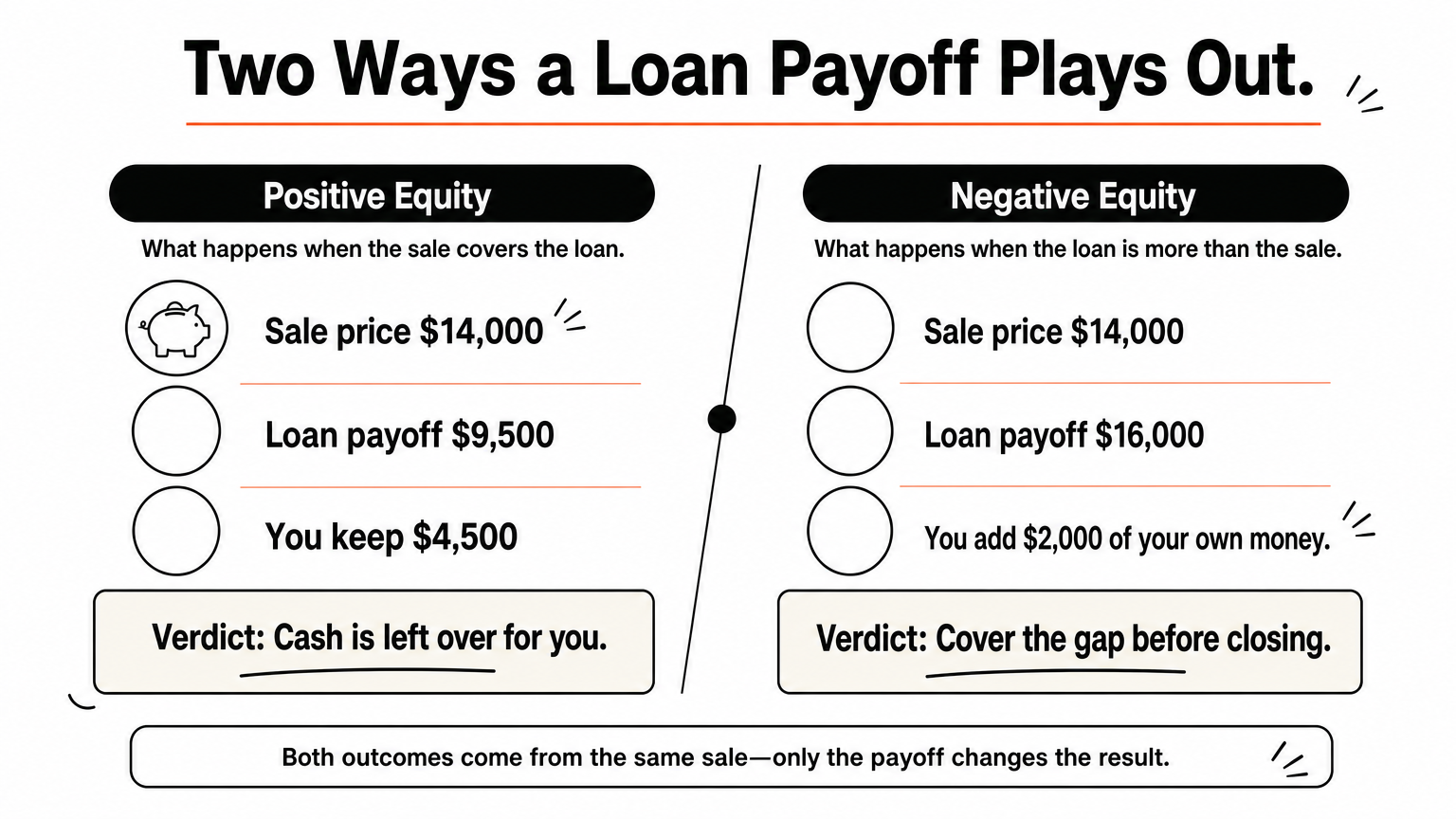
Here is how the numbers work for a car that sells at $14,000:
| Situation | Sale price | Loan payoff | What happens |
|---|---|---|---|
| Positive equity | $14,000 | $9,500 | Lender gets $9,500, you keep $4,500 |
| Negative equity | $14,000 | $16,000 | Lender gets $16,000, you add $2,000 of your own money |
Get the lender’s release in writing and keep a copy.
Watch out for
Do not let a buyer take the car on a promise that the loan will be sorted out later. Make sure the payoff clears first, or complete the sale at the lender’s branch.
Interest accrues daily, so the payoff changes. Ask for the per-day amount, and confirm how long the lender takes to release the title after payment. Some take several days, and your buyer will want that timeline up front.
Close the loan and the sale on the same day, or the buyer carries a risk you created.
3. Odometer disclosure statement
What it is
Federal law requires the seller to state the vehicle’s mileage in writing whenever ownership changes. The statement appears either in a box on the title or on a separate form from your DMV. Vehicles past a certain age are exempt, but most cars you sell privately are not, so assume you need it. The buyer’s state uses this number to process the title, and the buyer uses it to judge the car’s true condition.
How to get or complete it
Read the mileage straight off the dashboard on the day of the sale. Write the whole number without tenths of a mile. Then tick the right statement if the form offers choices: the mileage is the actual mileage, it is not the actual mileage, or it exceeds the odometer’s mechanical limits.
If your title has no mileage section, download your state’s separate odometer form. Both seller and buyer sign. A few states want the form notarized, so check before you meet.
Watch out for
The mileage must read the same on the title, the bill of sale, and any history report you share. A mismatch makes a buyer suspicious and can make the DMV reject the paperwork.
If you write a wrong number, do not cross it out. Ask your DMV how to correct the error, because altered entries can void the title. Honesty matters here as well, since misstating mileage is a federal offense.
Mileage is the one number that every document must repeat in exactly the same way.
4. Bill of sale
What it is
A bill of sale is a signed record of the deal. It shows who sold what to whom, for how much, and on what terms. Some states require one and many buyers need it to register the car. Even where it is optional, it is your best proof of the sale price and date if a dispute comes up later. Your DMV usually offers a free template, and a one-page version works fine.
How to get or complete it
Fill in these fields, then make two signed copies so each side keeps one:
- Full names and addresses of buyer and seller
- Year, make, model, and VIN
- Odometer reading
- Sale price and date
- A line stating the car is sold "as is," with no warranty
- Signatures of both parties
Take payment before you hand over keys. Cash counted at a bank or a cashier’s check that you verify with the issuing bank is safest. Avoid personal checks and payment apps that allow reversals.
Watch out for
Write the real price. Buyers sometimes ask you to list a lower number to cut their sales tax, but that is tax fraud and it exposes both of you.
Also be specific about "as is." This wording keeps you from being blamed for problems that show up later, but it only works if you have disclosed known defects honestly. If your state requires notarization, do it with the buyer present.
If it is not written down and signed, you cannot prove what you agreed to.
5. Release of liability and your state’s extra forms
What it is
A release of liability, sometimes called a notice of transfer, tells your DMV that you no longer own the car and records the date and time of the sale. It protects you from parking tickets, toll charges, and accidents that happen after the handoff. California’s version is the Notice of Transfer and Release of Liability (REG 138), and it sets a short deadline of five days. Other states have similar forms with different deadlines.
How to get or complete it
Most DMVs let you file online in a few minutes. You will need the VIN, license plate number, the buyer’s name and address, the sale date and price, and the odometer reading. Save the confirmation and take photos of the signed title and bill of sale for your records.
Beyond that form, states differ on a handful of other requirements:
| Item | What to check with your DMV |
|---|---|
| Emissions or safety inspection | Some states require the seller to provide a recent pass |
| License plates | They stay with the seller in some states and with the car in others |
| Registration | Often canceled or transferred at the DMV, not by the buyer alone |
| Notarization | Required for the title or forms in a few states |
| Insurance | Cancel only after the release is filed and the buyer has the car |
Watch out for
Do not skip the release because the buyer promised to retitle the car. Buyers delay for months, and until your DMV record changes, you are the owner on paper. File the same day.
Also keep your insurance active until the paperwork is filed. Once the filing is confirmed, tell your insurer you have sold the car so you can stop paying for it or move coverage to your next vehicle.
Handing over the keys ends your possession, but only the DMV filing ends your responsibility.
6. Service records, history report, and warranty papers
What it is
These are not legally required, but they are what turns a hesitant buyer into a paying one. A complete packet shows how the car was cared for and answers questions before they are asked. Private buyers pay more for a car with a documented history, and the packet shortens negotiation because there is less to doubt.
| Document | Required? | Where to get it |
|---|---|---|
| Service and maintenance records | No | Your shop, the dealer portal, or your own receipts |
| Vehicle history report | No | VIN-based report providers |
| Warranty or service contract | No | The provider; confirm it is transferable |
| Owner’s manual and all keys | No | Glovebox and your key drawer |
How to get or complete it
Collect receipts into a one-page summary with date, mileage, and work done, newest first. Order a vehicle history report and check that its mileage and VIN match your title. Call any warranty provider to confirm what transfers and how.
Then prepare the car itself:
- Check what similar cars sell for locally. A free valuation report, such as the ones Car Trackers offers, gives you a market value to price against.
- Clean and detail it before taking photos.
- Photograph every angle, plus any dents or scratches.
- Write an honest listing with mileage, condition, and price.
Watch out for
Do not promise warranty coverage you have not verified. Tell the buyer to confirm terms with the provider, and note "as is" on the bill of sale if coverage is not transferable.
Meet in a public place during the day, such as a bank lobby, and bring someone with you. Photograph the buyer’s license before any test drive, and ask your insurer whether your policy covers one. Redact your address and payment details on any receipts you hand over.
A tidy records packet answers the buyer’s questions before they become reasons to lower the price.
Sell with your paperwork ready
Selling privately comes down to six items: a properly signed title, a lender’s release if you owe money, an honest odometer disclosure, a bill of sale, a release of liability filed the same day, and a records packet that backs up your price. Check your state’s DMV page for its exact forms and deadlines, then gather everything before the first buyer calls.
If that sounds like more time than you want to spend, you have another route. With Car Trackers, you complete a 10-minute video appraisal from your phone, get a final offer right away, and licensed appraisers handle the paperwork. Payment arrives by same-day wire when the car is picked up. You can get a free, no-obligation offer from Car Trackers and compare it with what a private sale would take.
