

The sell vs trade in car decision is a trade of money for convenience. When you sell, you find the buyer yourself, usually a private buyer, and keep the full price. When you trade in, a dealer buys your car and credits its value toward your next one. Selling usually pays more. Trading in is faster, simpler, and in many states lowers the sales tax on your next car.
The gap between the two is real, but it is rarely as big as the headline offers suggest. This article shows why dealers offer less, how tax rules change the math, and how to compare the numbers for your own car. You also get a side-by-side table and a list of mistakes that cost sellers money.
Car Trackers buys cars through a 10-minute video appraisal, so we also cover the third route that sits between selling privately and trading in. You can then weigh all three on equal terms.
Why the choice between selling and trading in matters
The two routes can differ by hundreds or even thousands of dollars, and by days or weeks of your time. Most owners underestimate both costs, so it helps to see where each one comes from.
Why dealers pay less for a trade-in
A dealer pays less because it has to resell your car at a profit. It subtracts the cost of cleaning, repairs, and holding the car on its lot, then adds a margin. That puts a trade-in offer closer to wholesale value, while a private buyer pays closer to retail price.
Bundling hides the difference. When you trade in while buying, the dealer can move numbers between the trade-in value, the new car’s price, and the financing. Ask for the trade-in figure on its own, and compare it with an outside offer before you discuss the new car.
How the sales tax credit narrows the gap
In many states, the trade-in value is subtracted from the new car’s price before sales tax is calculated. Not every state does this, and California, for one, does not. Check your state’s tax agency or DMV rules before you count on the credit.
Here is a worked example. Your car would sell privately for $17,000 or trade in for $15,000. The new car costs $35,000, and your sales tax rate is 7%.
| Private sale | Trade-in | |
|---|---|---|
| Money for your old car | $17,000 | $15,000 |
| Taxable amount on the $35,000 car | $35,000 | $20,000 |
| Sales tax at 7% | $2,450 | $1,400 |
| Net after tax (money in minus tax) | $14,550 | $13,600 |
Selling still wins, by $950, but the $2,000 headline gap shrank by about half. In a state with no trade-in credit, you would keep the full $2,000.
Compare what you keep after tax, not the two offers on the table.
What the extra money costs you in time
Time is the other price. A private sale means photos, a listing, messages, test drives, no-shows, a bill of sale, and a title transfer. You will also meet strangers about a car worth thousands of dollars. A trade-in takes one visit, and the dealer handles the paperwork.
How to decide between selling and trading in
Compare what you would keep after tax and effort, then choose the route whose extra work you can live with. Four steps get you there.
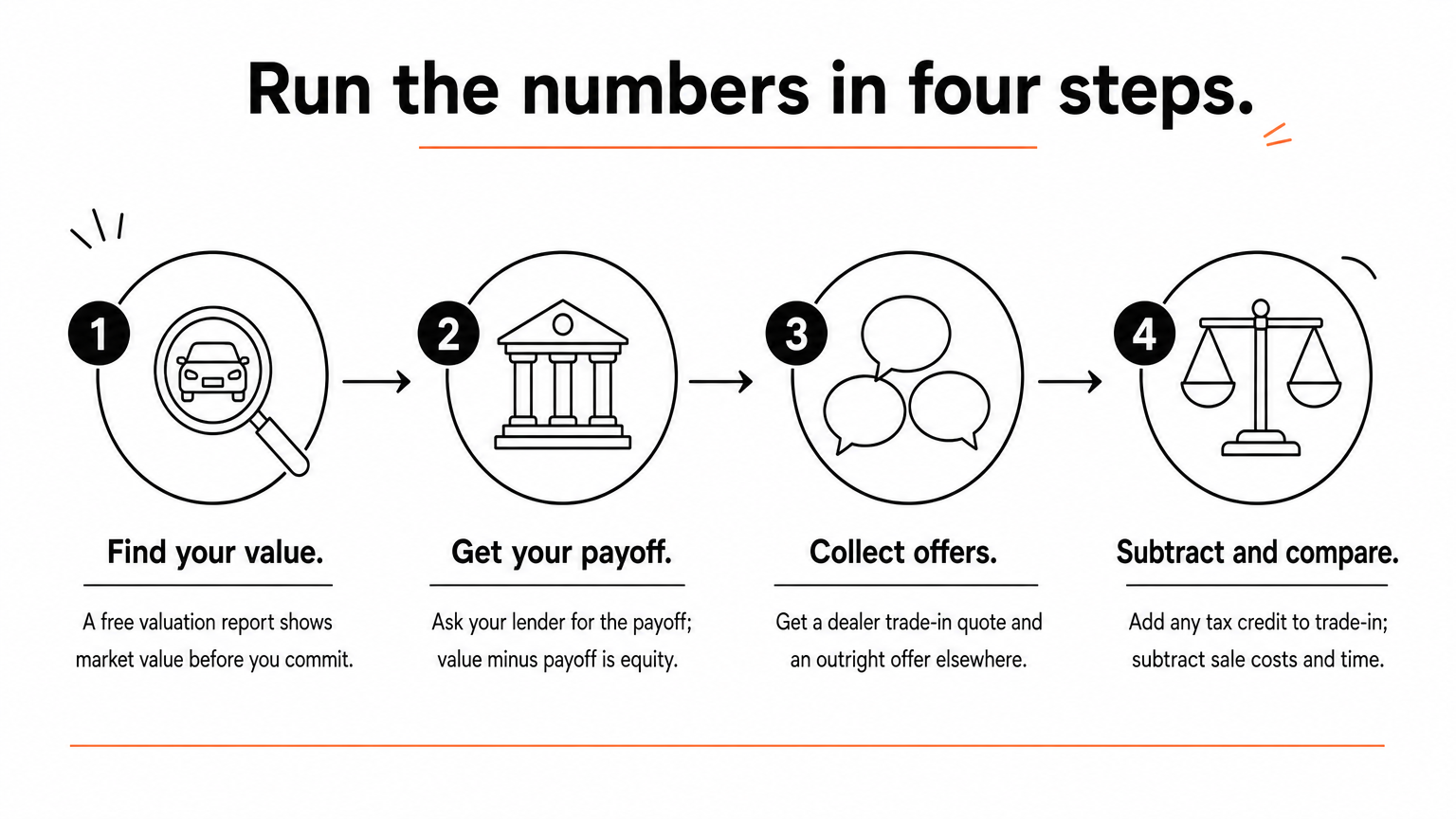
Run the numbers in four steps
- Find your car’s value. A free valuation report, such as the ones Car Trackers offers, shows the market value before you commit to anything.
- Get your payoff amount from your lender. Your value minus your payoff is your equity.
- Collect offers. Get a trade-in quote from at least one dealer, plus an outright offer from a buyer that is not the dealer you are buying from.
- Subtract and compare. Add any tax credit to the trade-in side. Subtract listing costs, repairs, and the value of your time from the sale side.
A workable rule of thumb: if selling beats the trade-in by less than a few hundred dollars after tax, trade in. If it wins by $1,000 or more, the extra work usually pays.
If selling nets only a few hundred dollars more, take the trade-in and keep your weekends.
When each route wins
Selling usually wins when:
- Your car is in demand, well maintained, or has low mileage.
- You are not in a hurry.
- Your state offers no trade-in tax credit.
Trading in usually wins when:
- You are buying your next car from the same dealer.
- Your state gives a sales tax credit.
- The car needs repairs you do not want to pay for.
- You do not want to deal with buyers.
What to do if you owe more than the car is worth
If your loan balance is higher than the car’s value, you have negative equity. Trading in rolls the shortfall into your next loan, so you start that loan further underwater. Selling means you must pay the difference to your lender to release the title. Either way you owe the gap, so the cleanest fix is to pay it down first or cover it in cash before you switch cars.
Selling, trading in, and a remote buyer compared
A third route sits between the two: selling outright to a remote buyer that gives an instant offer. It skips the listing and the strangers of a private sale, and it is not tied to buying another car, as a trade-in is.
Side-by-side comparison
Here is how the three routes stack up on the factors that matter most.
| Factor | Private sale | Dealer trade-in | Remote instant offer (Car Trackers) |
|---|---|---|---|
| Payout | Highest potential, near retail | Lowest, near wholesale | Competitive, can beat dealer offers by up to $1,000 |
| Speed | Days to weeks | Same visit | Offer after a 10-minute video call, same-day wire on pickup |
| Effort | High: listing, messages, test drives | Low | Low: one video call |
| Paperwork | You handle it | Dealer handles it | Licensed appraisers handle it |
| Sales tax credit | None | Often, depending on your state | Usually none, since you are not buying from the buyer |
| Condition | Buyers inspect closely | Often accepted as is | Assessed during the video appraisal |
The tax row is the one to check against your state, because it can swing the result as the earlier example showed.
How a remote instant offer works
With Car Trackers, you submit your vehicle details online and book a video call. A licensed appraiser assesses the car through your smartphone camera from your home, work, or anywhere with a network. You get a final offer instantly after the call. If you accept, pickup is scheduled at your convenience, and payment arrives by same-day wire when the car is picked up. The appraisers also manage the DMV paperwork and title transfer.
The appraisal is free and carries no obligation, so it works as a check on any dealer’s trade-in figure. Car Trackers also matches or beats a competing dealer offer, by up to $1,000 more.
A free, no-obligation offer turns a trade-in quote from a guess into a number you can test.
Mistakes that cost sellers money
Most losses in either route come from rushing the numbers or the paperwork. These are the ones to avoid.
Mistakes when trading in
Trade-ins go wrong when you let the deal blur. Negotiate one number at a time, and keep the dealer’s quote in writing.
- Accepting a single quote without an outside offer to compare.
- Negotiating the trade-in, the new car, and the monthly payment as one bundle.
- Not asking how long the trade-in offer stays valid.
Mistakes when selling
Private sales go wrong on price and payment. Price against similar listings rather than hope, and make sure the money is real before the car leaves.
- Handing over keys and title before your bank confirms the funds.
- Skipping the bill of sale.
- Forgetting to report the sale to your state DMV where required.
Know your numbers before you walk in, and verify the money before you hand over the keys.
Pick the route that fits your car and calendar
Selling usually pays more, and trading in wins on speed and sometimes tax. The gap is smaller than it looks once you count the sales tax credit, your time, and any money you still owe on the car. Run the four steps, compare what you keep, and choose.
If you want an offer without listing the car or driving to a dealership, get a free instant offer from Car Trackers. It takes a 10-minute video appraisal, carries no obligation, and gives you a real number to hold against any trade-in quote.
