

The Toyota RAV4 vs Honda CR-V choice comes down to five things: price, reliability, fuel economy, power, and space. The RAV4 suits you if you want the best fuel economy and the strongest hybrid power. The CR-V suits you if you want more rear-seat and cargo room, the option of a gas engine, and a slightly lower repair-cost record. The two cost almost the same, so the sticker price should not decide it.
Both SUVs are good, which is exactly why shoppers get stuck. The 2026 RAV4 is hybrid-only, while the current CR-V still comes with a turbocharged gas engine or a hybrid system. That changes which versions you should compare, and many head-to-head reviews skip that point. Below you get five items, each with the numbers and a clear verdict.
At Car Trackers we buy vehicles from owners online, so we know a new-car decision usually starts with a second question: what is your current vehicle worth? We cover that at the end. First, the comparison.
1. Price and what you actually pay
The RAV4 and CR-V start within about $500 of each other, so price alone will not separate them. Compare the versions you would actually buy, not the base trims.
What the numbers say
Listed starting prices put the CR-V at about $33,070 and the RAV4 at about $33,495. The gap is roughly $425.
| Honda CR-V | Toyota RAV4 | |
|---|---|---|
| Listed starting price | about $33,070 | about $33,495 |
| Powertrains | turbo gas or hybrid | hybrid only |
Because the 2026 RAV4 is hybrid-only, the fair match is the RAV4 against the CR-V Hybrid. The hybrid CR-V typically costs more than the gas CR-V, which makes the RAV4 the better value if you want a hybrid.
Who comes out ahead
The CR-V with the gas engine has the lowest entry price if you do not want a hybrid. If you do want one, the RAV4 usually costs less than the CR-V Hybrid at similar trim levels. Ask each dealer for an out-the-door quote before comparing.
The RAV4 is the better hybrid value, and the gas CR-V is the cheaper way in.
2. Reliability and resale value
Both SUVs are among the most dependable compact SUVs you can buy, so reliability is a narrow call in this matchup. The CR-V has a slight edge on repair costs, and the RAV4 carries the risk of a freshly redesigned model.
What the numbers say
- Repair costs: the independent tracker RepairPal lists a lower annual repair cost for the CR-V.
- Known issues: earlier CR-Vs with the 1.5-liter turbo drew oil dilution complaints, mostly in cold climates. Check the service history on any used one.
- New design: the 2026 RAV4 is a redesign. First-year models of any generation can carry early bugs.
- Longevity: both regularly pass 200,000 miles with regular maintenance.
- Resale: both hold their value among the best in the class, and hybrids tend to hold it best.
Who comes out ahead
Buy the CR-V if you want the lower repair-cost record. Buy the RAV4 if you plan to keep it for a long time and want hybrid resale strength.
Neither will leave you stranded, but the CR-V has the cheaper repair record today.
3. Fuel economy and running costs
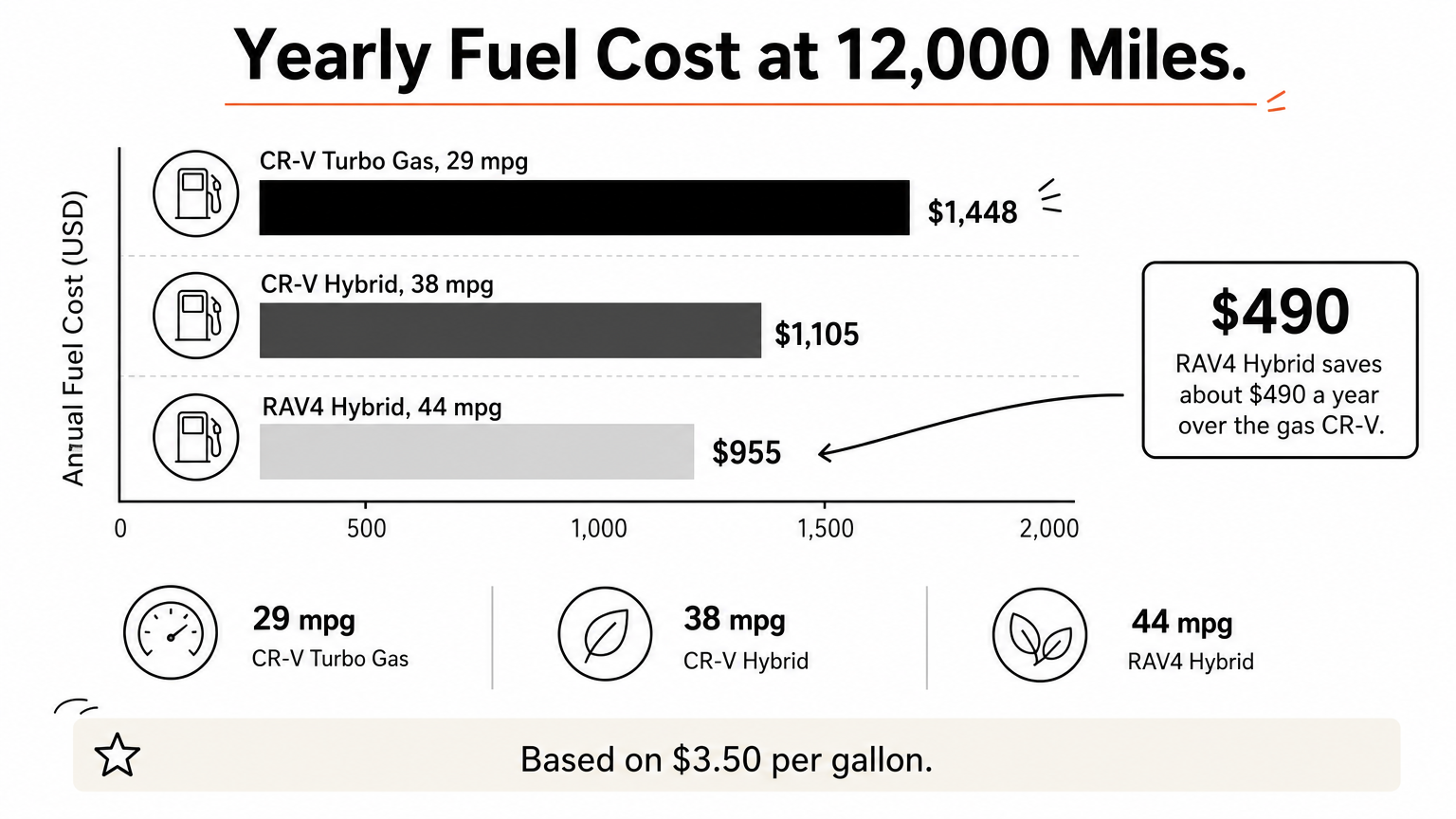
The RAV4 wins on fuel economy, because every 2026 RAV4 is a hybrid. The CR-V Hybrid is efficient too, but the gas CR-V is not in the same league.
What the numbers say
These are rounded combined mpg figures for illustration. Check the EPA numbers for your exact trim at fueleconomy.gov.
| Version | Approx. combined mpg | Fuel cost at 12,000 miles and $3.50 per gallon |
|---|---|---|
| CR-V, turbo gas | 29 | about $1,448 |
| CR-V Hybrid | 38 | about $1,105 |
| RAV4 Hybrid | 44 | about $955 |
In this example, the RAV4 saves roughly $490 a year over the gas CR-V and about $150 over the CR-V Hybrid.
Who comes out ahead
The RAV4 wins for high-mileage drivers and anyone commuting in traffic. Pick the CR-V Hybrid if you want most of that savings with a larger cabin. Skip the gas CR-V if fuel cost is a priority.
Over a year of average driving, the RAV4 Hybrid saves about $490 in fuel against the gas CR-V.
4. Power and driving feel
The RAV4 has more power, with about 236 horsepower from its hybrid system against 204 for the CR-V Hybrid. Power is only part of the story, though.
What the numbers say
| Version | Engine | Approx. horsepower |
|---|---|---|
| CR-V, gas | 1.5-liter turbo | 190 |
| CR-V Hybrid | 2.0-liter hybrid | 204 |
| RAV4 Hybrid | 2.5-liter hybrid | 236 |
The RAV4 pulls harder when merging or passing. The CR-V Hybrid feels smooth and quiet, and the gas CR-V is adequate but the least efficient of the three.
Who comes out ahead
The RAV4 wins on pure performance. Still, a power figure tells you little about ride comfort, road noise, or steering feel. Test drive both on roads you use daily, including the highway, before you decide.
The RAV4 has the stronger powertrain, but a test drive settles comfort.
5. Cargo space, interior, and features
The CR-V is the roomier of the two. It is a few inches longer than the RAV4, and that length goes into the cabin and the cargo area.

What the numbers say
Published figures put the CR-V at up to 39.3 cubic feet of cargo space behind the rear seats, against 37.6 for the RAV4. Hybrid versions can give up a little space to the battery, so compare the exact trim.
Both SUVs come with a standard suite of driver-assistance features, Honda Sensing on the CR-V and Toyota Safety Sense on the RAV4. Screen size, audio, and seat comfort vary by trim, so compare trims, not model names.
Who comes out ahead
The CR-V wins for families who carry strollers, sports gear, or tall passengers in the back. The RAV4 does enough for most buyers and has the edge if power and fuel economy matter more than space. Ask about towing capacity if you tow.
Choose the CR-V for room, and the RAV4 for efficiency and power.
Which one should you buy?
Buy the RAV4 if you want the lowest fuel cost and the strongest hybrid power. Buy the CR-V if you want more space, a gas engine option, or the lower repair-cost record. On price, the two are too close to call.
Before you shop, find out what your current vehicle is worth. Dealer trade-in offers often come in low. Car Trackers appraises your vehicle in a 10-minute video call, makes a final offer right away, and pays by same-day wire when the car is picked up. We beat most dealership offers by up to $1,000, and the appraisal is free with no obligation. To see what you could put toward your next SUV, get your offer from Car Trackers.
